
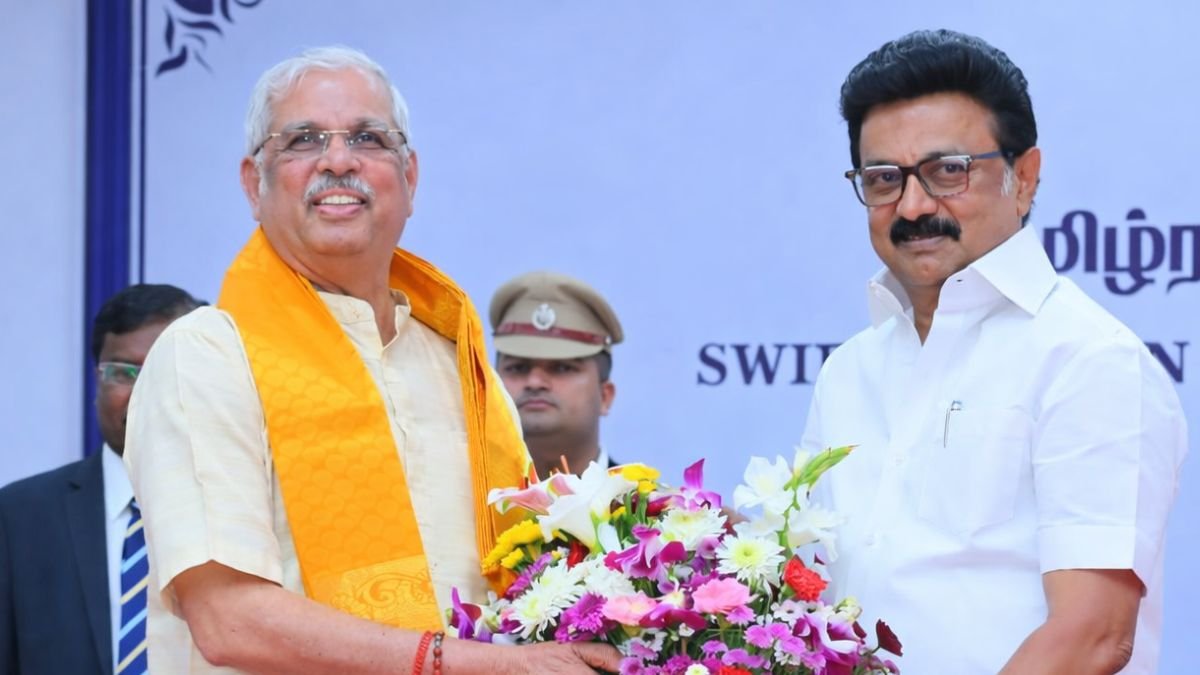
Tamil Nadu woke up to a significant constitutional transition on Thursday, March 12, as Rajendra Vishwanath Arlekar was sworn in as the Acting Governor of the state at the historic People’s Palace in Guindy, Chennai. The ceremony drew a full gathering of political and administrative dignitaries, marking the end of one of the most turbulent gubernatorial tenures in the state’s recent history.
The oath of office was administered by Chief Justice of the Madras High Court, Justice Sushrut Arvind Dharmadhikari. Chief Minister M.K. Stalin attended the ceremony alongside Assembly Speaker M. Appavu and several cabinet ministers, including K.N. Nehru, M.R.K. Panneerselvam, E.V. Velu, and Sekar Babu. Tamil Nadu BJP President Nainar Nagendran and former Telangana Governor Tamilisai Soundararajan were also among those present, as were senior state bureaucrats and senior police officials. Arlekar introduced the state’s Council of Ministers to the new Governor, who was also accorded a ceremonial guard of honour by the Tamil Nadu Police.
Arlekar, who holds primary charge as the Governor of Kerala, has been given the additional responsibility of Tamil Nadu until a permanent appointment is made by the President of India. He arrived in Chennai late on Wednesday night, ahead of the ceremony.
The 71-year-old is a seasoned political figure who brings a markedly different profile to Raj Bhavan. A native of Panaji, Goa, born on April 23, 1954, Arlekar has been associated with the Rashtriya Swayamsevak Sangh from his early years and joined the Bharatiya Janata Party in 1989. He was elected to the Goa Legislative Assembly twice — first in 2002 and again in 2012. He served as Speaker of the Goa Assembly from 2012 to 2015, during which the Goa Assembly became the first legislative body in India to adopt a fully paperless system. He also served as Minister for Forests, Environment, and Panchayati Raj under the late Chief Minister Manohar Parrikar, and was the state president of the Goa BJP from 2003 to 2007.
His gubernatorial journey began in July 2021, when he was appointed Governor of Himachal Pradesh. He subsequently moved to Bihar in February 2023, and later took charge as Kerala’s Governor in December 2024.
Arlekar’s appointment follows a sweeping reshuffle of Governors across nine states and Union Territories by the Union government. The immediate trigger was the sudden resignation of West Bengal Governor C.V. Ananda Bose, which set off a chain of reassignments. President Droupadi Murmu subsequently transferred outgoing Tamil Nadu Governor R.N. Ravi to West Bengal, an election-bound state with Ravi being sworn in as West Bengal’s Governor on the same day.
Ravi’s four-year tenure in Tamil Nadu had been marked by persistent friction with the DMK government led by Chief Minister Stalin. Over the course of his time at Raj Bhavan, he withheld assent to multiple Bills passed by the state legislature including those relating to the NEET examination and university vice-chancellor appointments and forwarded several to the President. He dismissed a cabinet minister without the Chief Minister’s concurrence, refused to swear in another minister, and walked out of the state Assembly on four successive occasions without delivering his customary address. The Supreme Court itself had taken note of the delay in assenting to state legislation.
Political observers note that while the DMK-Ravi standoff became a rallying point for the ruling party, Arlekar’s temperament is described as considerably more administrative and low-key. Whether that signals a smoother relationship between Raj Bhavan and the elected government remains to be seen particularly with Tamil Nadu’s state Assembly elections on the horizon. For now, as the People’s Palace settles into a new chapter, the state watches with cautious optimism.
-Samuthiran