A. S. Panneerselvan, Senior Journalist and Author
(Continued from Dravidian Narratives: Dignity Trumps Humiliation | Part 1)
However, the creative effort that helped DMK to position itself for the electoral politics was 1952-film Parasakthi. Earlier in a seminar, I recorded the central democratic role played by the film Parasakthi in transforming the Dravida Munnetra Kazhagam from being a political idea to a political reality. I have also pointed out that Kalaignar’s approach in Parasakthi was a conscious attempt to widen the support base of the DMK at a time when the political landscape was dominated by the Congress, the Communist Party of India and of course, Periyar’s Dravidar Kazhagam.
As I have mentioned elsewhere, it is important to understand the narrative structure deployed by Karunanidhi in the film to understand its full political and cultural import. It is basically the reverse of an epic narrative. In epics, the main element is the exile of the protagonists and the resolution that comes about with the end of exile and their happy return. Parasakthi starts with the end of exile, in a sense, an anti-climactic opening, when the protagonist Gunasekaran (played brilliantly by the debutant Sivaji Ganesan) returns to Tamil Nadu from Burma. The return is not a happy one; the situation at home that forced people to seek better prospects in exile, has become worse; it further fragments the family; creates a much larger cleavage between the rich and the poor; and the state machinery has no real plans to integrate the repatriates.
The naming of the characters, the deployment of songs extolling the virtues of Dravida Nadu by Bharathidasan, the use of a common bird – the crow – as a metaphor to drive home the importance of interdependency in a democracy are some of stylistic devises used by Karunanidhi to capture the imagination of the Tamils. For instance, Kalyani, the sister of the protagonist, and her husband want to name their child Panneerselvam, if it is a boy and Nagammai, if it is a girl. The allusions are clearly political. Panneerselvam denoted the well-known Justice Party leader Sir A.T. Panneerselvam and Nagammai, the activist of the Dravidian Movement and wife of Periyar EVR. The popular ‘Kaka Song’ (the crow song) rendered in a soulful manner by Chidambaram Jayaraman invokes the memory of a Sangam poet Kakkaipadiniyar (the poet who sung about crows) and it effectively deals with sharing, interdependency and addressing hunger as the fundamental developmental issue before a newly independent country.
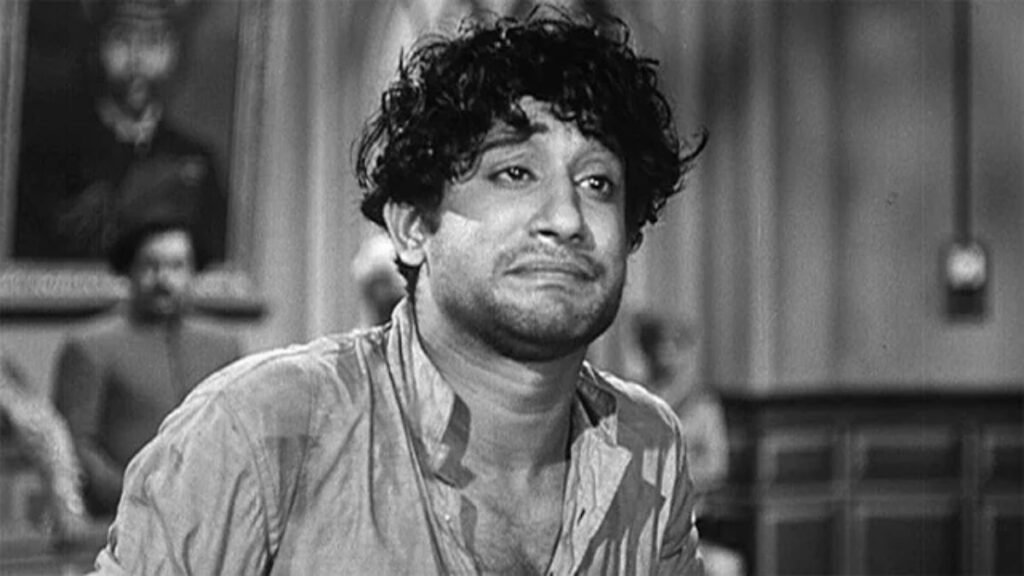
The film, in a sense, documents the shift from Periayarist maximalist positions to Annadurai’s realistic fallback positions. As Pandian points out in his essay, while ‘Parasakthi did attack religion in definitive terms, it also at once exhibited certain ambivalence about religion. This ambivalence comes out candidly in Gunasekaran’s vituperative monologue in the court—almost at the close of the film.’ The lengthy monologue: ‘I created trouble in the temple; not because there should not be temples, but because temples should not become the den of dangerous men. [I] attacked the ‘poojari’. Not because he is a devotee, but because devotion has become a daytime disguise. This is of course, as Pandian rightly asserts, is only a muted criticism of the religious order—it absolves religion and religious devotion but criticises only their misuse. ‘In fact, the film was passed by the Censor Board, because some of the members thought that the film had a hidden message of faith and belief. The sequence that gave them this feeling was the following: Kuppan hearing the cries of Kalyani from within the Parasakthi temple rings the bell frantically. As if in answer to the cries of Kalyani, help comes in time, from behind the idol… from the sanctum. On the screen, the image of ‘Parasakthi’ is superimposed on the ringing bell,’ wrote Pandian.
Here the key issue we need to remember is the distinction between the DK and the DMK on their respective positions towards faith: while the DK rejected religion in toto, the DMK rejected religious obscurantism. In 1953, a year after the release of Parasakthi, Periyar led a protest by breaking the idols of Pillayar. Anna’s response was akin to the dialogues of Parasakthi. He said: “I would neither break a Pillayar statue or a coconut (referring to the religious offering)”. This fine distinction is the one that propelled Kalaignar as the Chief Minister to nominate the reformist pontiff Kundrakukudi Adigalaar to the legislative council, to introduce Tamil archanai and to legislate a law that permitted priesthood for all, regardless of caste. The challenges the government had to face is one example of the political wrestling between a reformist poltical imagination and a status quoist judiciary.
The film also teaches us some valuable lessons in creative excursions to subvert dominant narratives and restrictive censors. Much before the 1975 Emergency, this film provided us with the tools for creatively confronting the forces of status quo. Pandian documents the arguments of the critics of the film. He wrote: “Interestingly, the critics even pointed out that the film had carefully deployed ingeniously-devised techniques to bypass the scissors of the censors. One of them reasoned that the makers of the film were deliberately showing a mad man abusing the gods and the government so as to escape censorship. S/he claimed, the film converts a normal man into one of madness because the Censor Board would not pass the film if the abuses were delivered by a person in his normal self. Another petitioner, the by-now-familiar Tamilan, made reference to why the story of the film was located in pre-independence 1942.” Here the central political import is that by making either a temporal or a spatial journey, one can address the contemporary political reality in an analogous manner. People understand the full import of every political and cultural reference because they are not a passive recipient of moving images but an active listener to the tone and the tenor of the film.
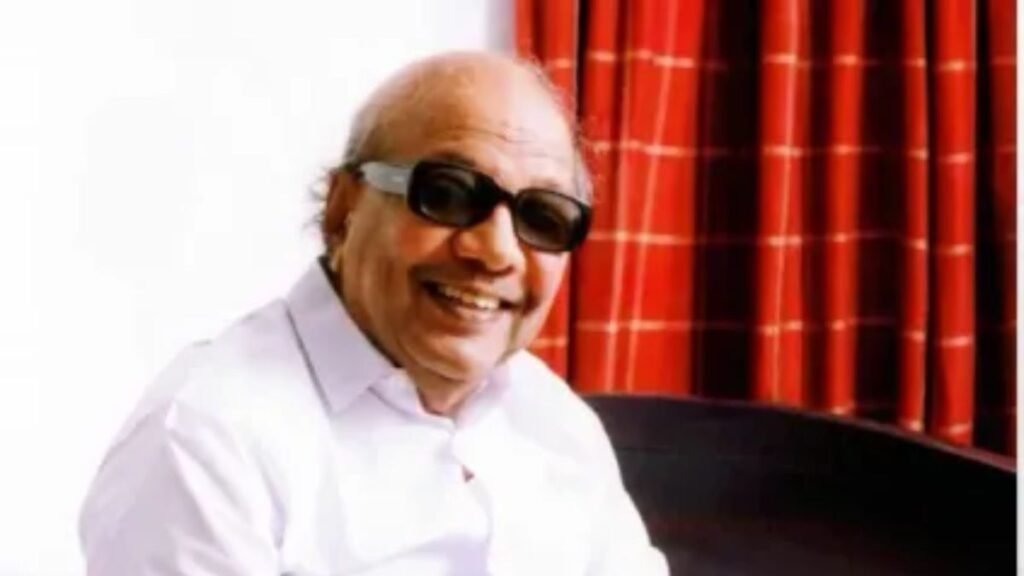
In his essay for Frontline magazine headlined “Cinema for a cause”, Karunanidhi explained his politics and film making in a succinct manner. He wrote: “I used films to spread rationalist ideas among people. My objective in writing for films was to avoid obscenity and highlight the principles of the Self-Respect Movement and thereby appeal to the intellect of the viewers.” The respect of the general public’s intellect is the one that made this significant poltical film both an artistic as well as a commercial success.
Apart from creative outputs, the movement generated substantial amount of intellectual capital, which indeed become the seed of the later day political manifestos. “Rule of the commoner” records the profound impact created by Anna’s lengthy political polemical texts: Arya Mayai (The Aryan delusion) and Illatchya Varalaru ((The Righteous History). Along with these two texts, Anna also produced an economic treatise called ‘Panathotam’ (Garden of Money). This truly irked the Left. Ramamurthy, a Left veteran, mounted a strident criticism of Panathotam which was effectively countered by Kalaignar in Murasoli. In the immediate days following Independence, Kalaignar wrote an insightful article for Kudiarsu. One of the best articles of that period, it remains a hallmark of good journalism even today. Titled “Theetayuduthu”(It’s polluted), the article was a frontal attack on the Thiruvayaru Thyagaraja Festival’s humiliation of the Tamil language. During the annual festival one of the singers rendered a Tamil song at the end of his performance in honour of Tyagaraja. The next singer refused to sing till the place was ‘purified’ as it had been polluted with a Tamil song. The organizers immediately called for priests to perform a special puja to purify the place; they cleaned the concert stage with holy water and then invited the next singer to perform. This episode captures the status of the Tamil language, especially in Carnatic music circles, before Independence. Tamil composers were not held in high esteem in this fold.
Much has been written about Kalaignar’s act of defiance during the Emergency and his (another adjective?) journalistic subversive act defiance with the publication of a cartoon panel. Chellappan, one of the finest cartoonists of Tamil Nadu, created a panel called ‘Metamorphosis’, featuring Indira Gandhi slowly being transformed into Hitler. While this cartoon was republished in the magazine Newsweek, the government did not permit any of Chellappan’s cartoons to appear till the revocation of the Emergency. The use of cartoon was perfected by the Movement and the 1962 election manifesto itself was in the form an illustrated cartoon book. The visual grammar was central to the Self-Respect polemics as much as the import of the words.
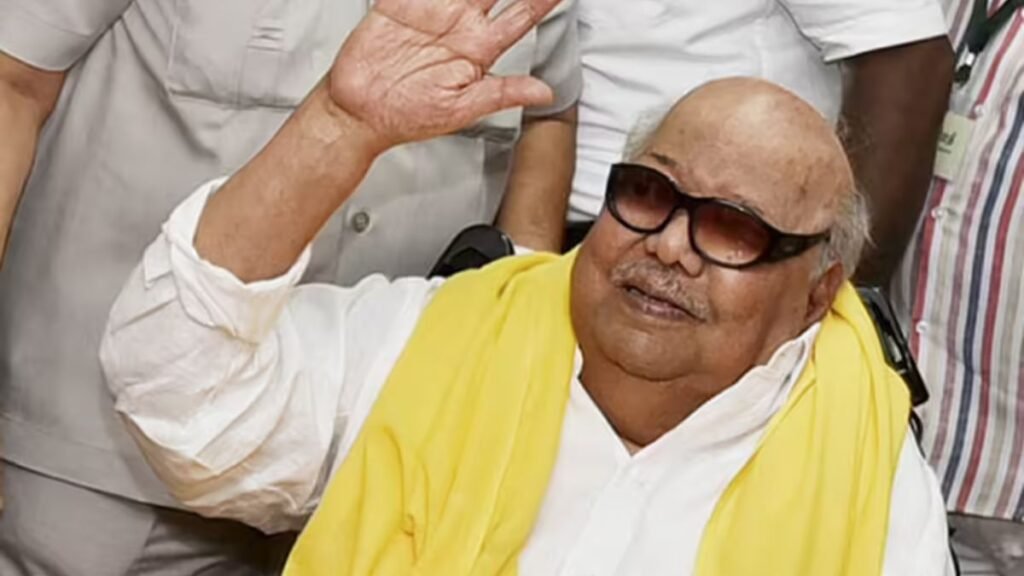
Kalaignar in an interview to this writer said that the Second International Tamil Conference gave an opportunity for the state government to also invest in public art. The Marina promenade had two iconic sculptures—Mahatma Gandhi, and the Triumph of Labour. As a PWD minister, Kalaignar arranged to commission the statues of ten stalwarts, for their definitive contribution to Tamil consciousness over two millennia. The statues were of Thiruvalluvar, Avvaiyar, Kambar, G.U. Pope, Robert Caldwell, Subramania Bharathi, Bharathidasan, V.O. Chidambaram Pillai, Veeramamunivar (the Tamil name of the Italian priest, C. J. Beschi who played a key role in the compilation of the first Tamil lexicon and who translated some of the ancient Tamil texts such as Thirukkural, Devaaram, Thiruppugazh, Nannool and Aaththichoodi), and Kannagi.
‘There are works by the great sculptor Rodin outside the British Parliament. The striking works of D.P. Roy Choudhury were the last set of public art in Chennai. Our commission of these ten statues gave a new fillip to the idea of public art in Tamil Nadu,’ he recollected.
The paper provides only a glimpse of the prodigious output from the movement and it touches upon the works of some of the leaders alone. From S.S. Thennarasu to T.K. Srinivasan, there are more than 1,000 works of fiction created by the ardent followers of the movement. Scholars like K.G. Radhamanalan and Karunanandham have written consistently about the movement. K.Anbazhagan’s lecture at the University of Madras about the Dravidian Movement and its egalitarian imagination is a succinct lesson in civilization, history and politics. V.R. Nedunchezian’s studied critique of Parimelazhagar’s attempt to Brahminise Thirukural had become a bedrock of multiple publications that worked tirelessly to keep the wonders of Thirukural within the secular and universal fold. There are diabolic attempts to reduce the Thirukural to a religious text, but it is the considered articulations of the Self-respect movement that has provided a protective ring around these 1,330 couplets. Scholars tend to reduce the Thirukkural to an all-inclusive ethical guide; a prescriptive compendium or a text that spells out the rules for good governance. They tend to overlook the 230 couplets that deal with the world of desire and senses. Thirukkural deals with both the personal and the political – which is the way classical Tamil divided into two categories of Agham and Puram. The beauty of the Kural lies in the fact that its Puram, its essential politics, is embellished by its celebration of love and desire. For instance, the third section which celebrates desire is a testament for Thirukkural’s celebration of human body, passion, and importantly, a sense of ache. Body, as these couplets show, is central to both politics and personal. And, the self-respect movement played a key role to retain the materialist reading of these words of wisdom. I need to end this presentation with my unfinished research. While working on the biography of Kalaignar, he spoke about his last creative effort. It was to script a television series on Ramanuja, the 11th century proponent of the Visishtadvaita philosophy, in 2015, a year after Narendra Modi’s ascension as the prime minister. He chose Ramanuja because he transcended religion and caste and wanted all communities to be treated equally. The idea of using a religious philosopher, with a large following, to counter Hindutva was a sharp move, but, surprisingly, its expression was in an analog rather than digital format. Two areas which he wanted to discuss with me in detail were his ideas for the digital space and how his approach to Ramanujar was different from that in Indira Parthasarathy’s famous 1996 play Ramanujar. But his failing health did not permit us to have this discussion.
A.S.Panneerselvan is an author and journalist with more than four decades experience. After holding Key responsibilities in mainstream media organizations such as the Hindu, Sun TV, Outlook among others, he is the author of the biography of elder statesman M.Karunandhi published by Penguin Random House in 2021.