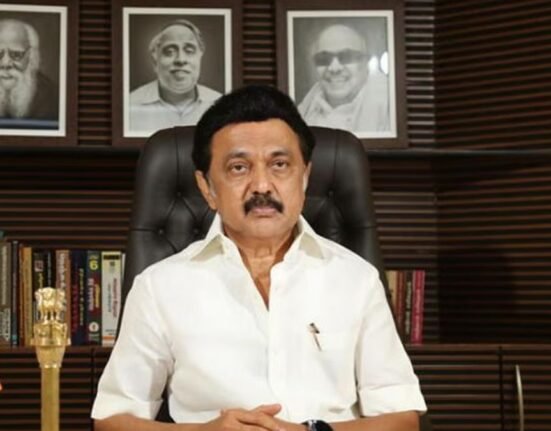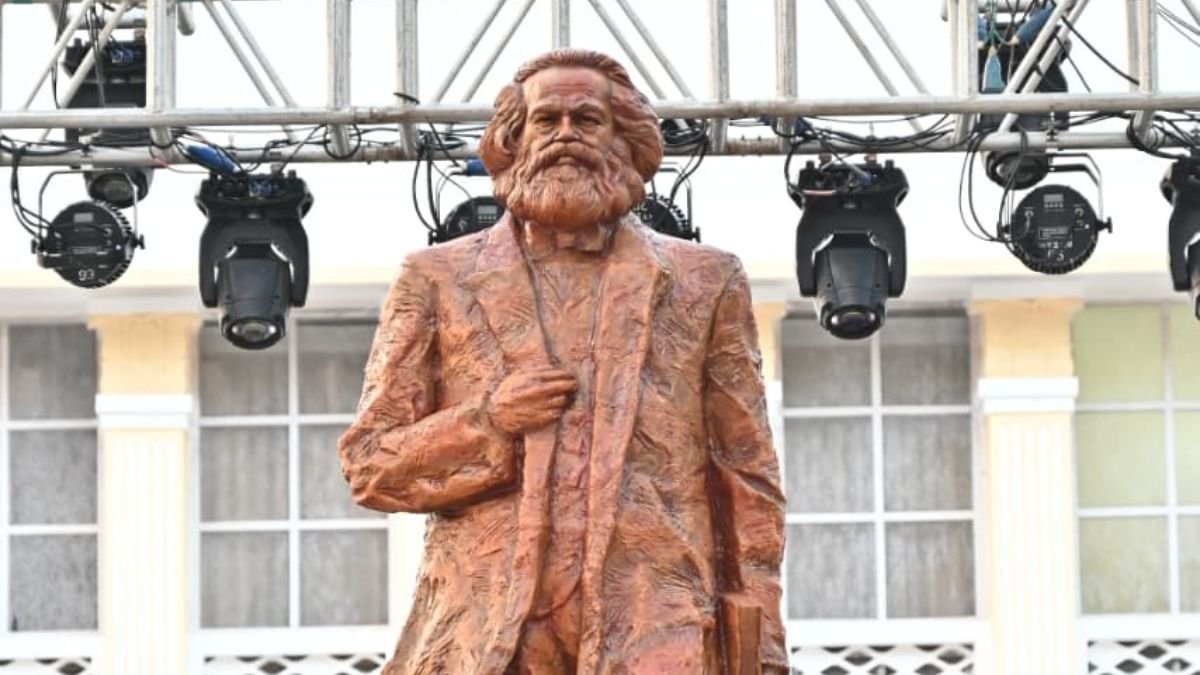
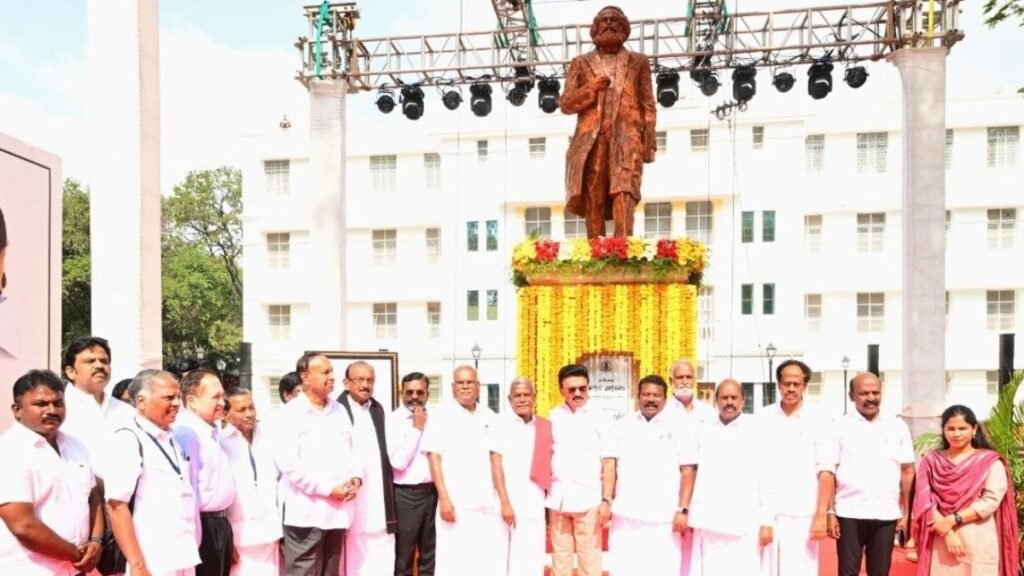
In a symbolic affirmation of political heritage and progressive ideology, Chief Minister M.K. Stalin unveiled a life‑size statue of German philosopher and economist Karl Marx at the entrance of the Connemara Public Library in Egmore, Chennai, on Friday.
“Installing Marx. Uninstalling inequality. Chennai reaffirms red,” CM Stalin wrote on social media, adding, “We draw strength from progressive ideas, no matter where they come from. When forces of domination attempt to prevail, we resist them. This is the essence of our Dravidian Model.”
The statue, reportedly costing around ₹85 lakh, underscores Marx’s enduring global influence on socio-economic and political thought. The project follows a proposal first announced by the Chief Minister in the Tamil Nadu Assembly in April 2025.
“A Significant and Joyful Event”
The unveiling ceremony saw participation from leaders of allied political parties. Present at the event were CPI(M) Tamil Nadu Secretary P. Shanmugam, CPI Secretary M. Veerapandian, VCK chief Thol Thirumavalavan, MDMK chief Vaiko, and Tamil Nadu Congress Committee president K. Selvaperunthagai, all of whom paid floral tributes to Marx.
A photo exhibition depicting key moments from Marx’s life and his philosophical contributions was also showcased at the library, giving visitors a chance to engage with the thinker’s intellectual legacy.
Commenting on the occasion, CPI(M) General Secretary M.A. Baby described the event as “significant and joyful,” writing on X, “Marx presented a revolutionary theory with the power to transform society and to liberate humankind from the clutches of exploitation and social oppression. We have seen immense advancements in countries where this revolutionary theory was applied. On this occasion, we offer our warmest congratulations to the Chief Minister and the Government of Tamil Nadu.”
The Political Debate
While the installation received widespread praise from supporters of leftist and progressive ideologies, it also sparked debate in political circles. Some opposition leaders questioned the relevance of Marx to Tamil Nadu, pointing out that he had no direct connection to the state and had never visited India.
Senior BJP leader and former Telangana Governor Tamilisai Soundararajan remarked that while Marx’s ideas have global significance, installing his statue in Chennai lacked historical context.
Marx, Tamil Nadu, and Historical Connections
Historians and scholars, however, point to multiple references in Marx’s own writings and collected notes that demonstrate a meaningful connection with developments in South India under British colonial rule.
Between 1853 and 1858, Marx wrote more than 30 articles and historical notes on India for the New-York Daily Tribune and other outlets, later compiled and translated into collections published in Moscow. His writings covered British colonial practices, Indian society, and the economic and political conditions of the subcontinent. These documents include at least 30 distinct references to the Madras Presidency, the colonial administrative unit that encompassed much of present-day Tamil Nadu.
One notable example comes from Marx’s 1857 analysis of the Madras Torture Commission Report, presented before the British House of Commons. In this piece, Marx highlighted the exploitation and systemic cruelty of colonial officials in the Madras region, citing specific incidents where local people were forced to provide labor and materials for public works without compensation. When they protested, they were subjected to physical violence — an episode Marx used to illustrate the oppressive nature of British rule.
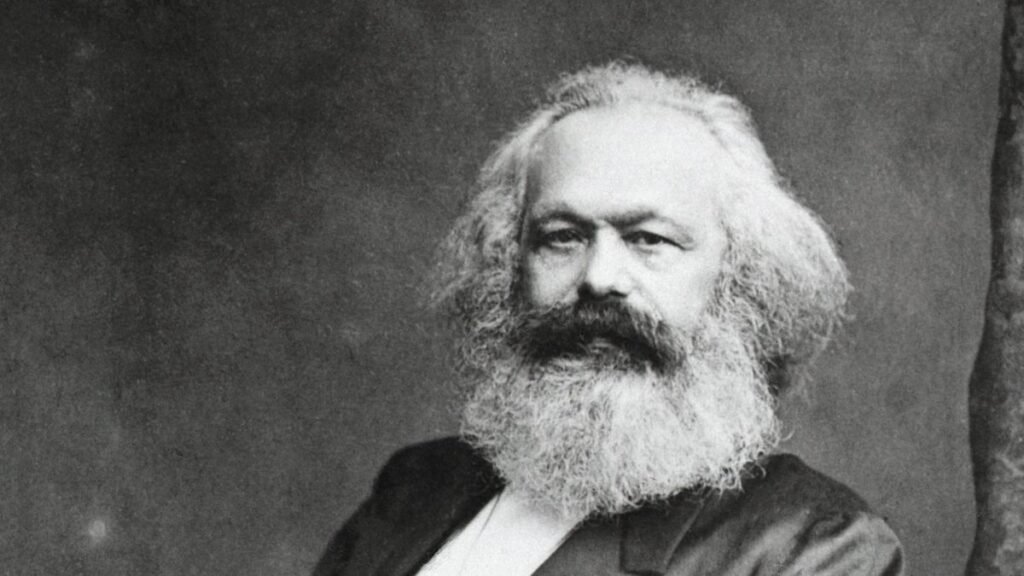
Beyond colonial administration, Marx’s collected notes also reference ancient Tamil kingdoms, such as the Chera, Chola, and Pandya dynasties, and discuss the linguistic and cultural landscape of South India, including the prevalence of Tamil and other Dravidian languages.
According to his writings: “Around the 5th century BCE, the Pandya country was established by a minor king of the same name; it was a small kingdom whose capital was the ancient city of Madurai, and whose territory included the present-day districts of Madurai and Tirunelveli in southern Karnataka. The kingdom remained independent until 1736 CE, when it was captured by the Arcot Nawab. The Chola country, where the Tamil language was spoken, was captured in 1678 by a Maratha commander named Venkoji, who took control of Thanjavur. The Chera country was a small principality that included Thiruvithankur, Coimbatore, and parts of Malabar.”
These observations demonstrate Marx’s interest not only in colonial India but also in its historical kingdoms, regional identities, and cultural heritage, highlighting that he studied and documented South India and Tamil-speaking regions in depth.
A Statement of Ideology and Education
For Mr. Stalin and his allies, the installation of Marx’s statue reflects the Dravidian Model’s commitment to social justice, equality, and progressive values. Positioned at a historic public library, the statue serves as both a political symbol and an educational tool, inspiring students, scholars, and citizens to explore Tamil Nadu’s history, Marxist thought, and the enduring relevance of social and economic equality.
– Magizh