
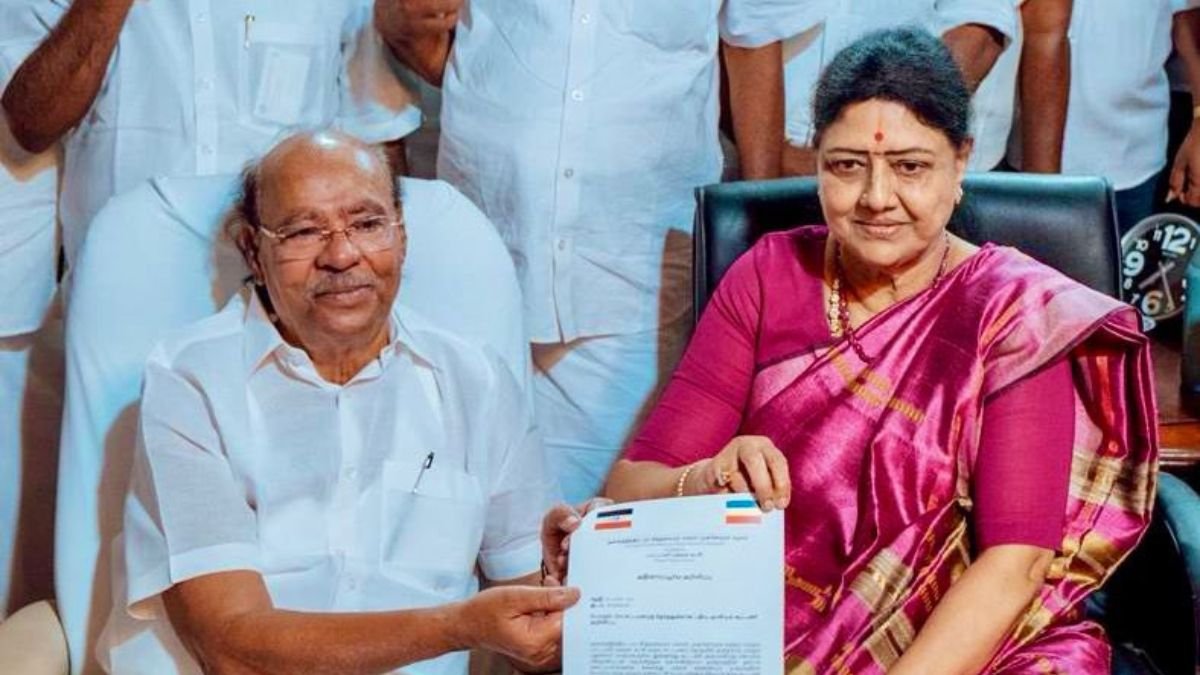
Tamil Nadu’s already complex electoral map acquired a new dimension on Thursday, March 20, when V.K. Sasikala and PMK founder S. Ramadoss formalised a written alliance agreement to contest the April 23 assembly elections together, fielding candidates across all 234 constituencies in Tamil Nadu and Puducherry.
The pact was signed at the Tailapuram residence of S. Ramadoss, where Sasikala visited him to conclude the negotiations the two had initiated at a meeting on March 10. After the signing ceremony, both leaders held a joint press conference to publicly confirm the alliance and present a united front ahead of the poll announcement.
The official alliance statement declared: “The All India Puratchi Thalaivar Makkal Munnetra Kazhagam and the Pattali Makkal Katchi hereby joyfully announce that they are forming an alliance to contest the upcoming Assembly elections in Tamil Nadu and Puducherry together. This alliance will work to remove the marks of betrayal in Tamil Nadu and to promote the welfare of the people, the self-respect of Tamil Nadu, and enhance its autonomy.”
The alliance brings together two political figures navigating the fringes of Tamil Nadu’s mainstream power structure. V.K. Sasikala, the long-time confidante of late Chief Minister J. Jayalalithaa launched the All India Puratchi Thalaivar Makkal Munnetra Kazhagam (AIPTMMK) after completing a four-year prison sentence in a disproportionate assets case. Despite her proximity to Jayalalithaa’s legacy, Sasikala has struggled to establish a significant electoral footprint since her release, with the AIADMK firmly rebuffing any possibility of her rejoining its fold.
Ramadoss, the 82-year-old PMK founder and a towering figure among the Vanniyar community of northern Tamil Nadu, finds himself in an unusual position for this election. His son R. Anbumani Ramadoss now controls the party structure and has steered PMK into alliance with the AIADMK-led NDA. This has effectively sidelined the elder Ramadoss from his own party a rare and politically charged family split that has attracted wide attention. By aligning with Sasikala, Ramadoss is mounting an independent challenge to both the NDA and the DMK-led coalitions, and his primary target terrain is expected to be the Vanniyar-dominated constituencies of northern Tamil Nadu, where the community’s loyalties have historically shaped election outcomes.
With this alliance now formalised, Tamil Nadu’s election contest has officially taken on a five-cornered shape. The principal battles will be fought between the DMK-led Secular Progressive Alliance, the AIADMK-led NDA, and TVK’s Tamilaga Vettri Kazhagam — which has declared it will contest all 234 seats independently. The Sasikala-Ramadoss combine adds a fourth front, while Naam Tamilar Katchi and several smaller formations round out the picture further.
Whether this fourth front has the organisational depth and community mobilisation ability to cause meaningful upsets in target constituencies, or whether it will simply add noise to an already crowded ballot, is a question that only polling day will answer. Tamil Nadu votes on April 23, 2026. Counting is scheduled for May 4.
-Samuthiran