
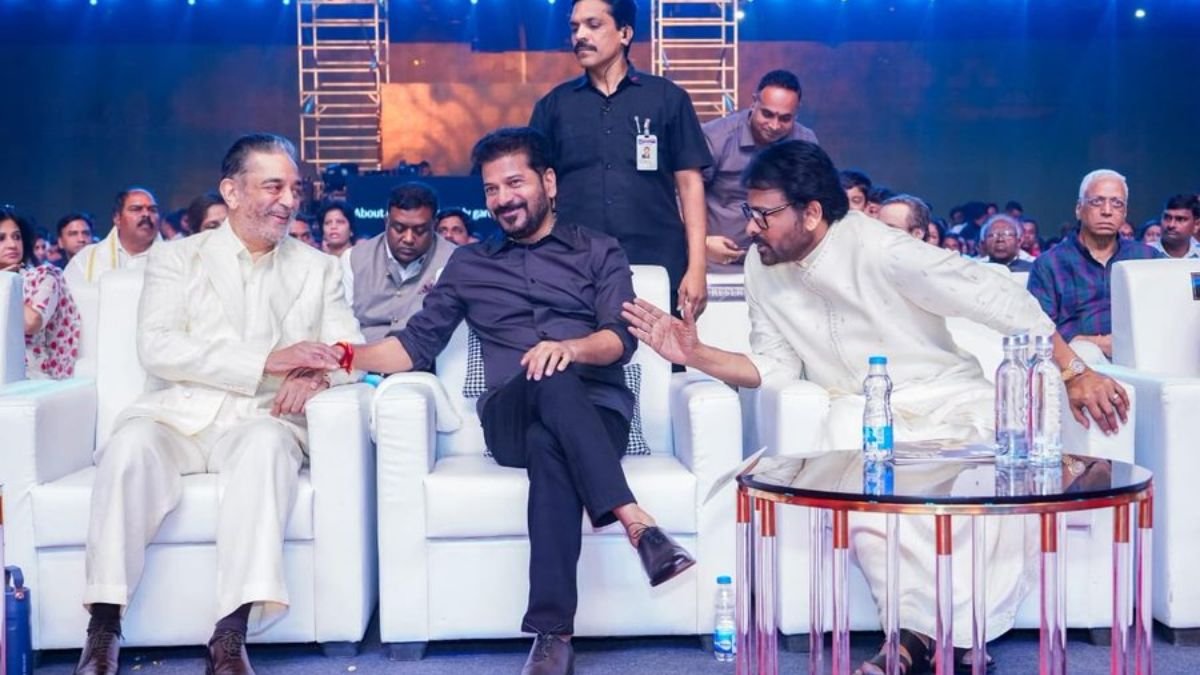
On the occasion of Ugadi, the Telangana government hosted the second edition of the Telangana Gaddar Film Awards on the evening of March 19, 2026, at the HITEX Convention Centre in Hyderabad and among the evening’s most celebrated moments was the honouring of legendary actor Kamal Haasan with the prestigious Paidi Jairaj Film Award, presented to eminent film personalities for outstanding contribution to Indian cinema.
The award was presented to Kamal Haasan by actor Nagarjuna, in the presence of Telangana Chief Minister A. Revanth Reddy, Deputy Chief Minister Mallu Bhatti Vikramarka, and Minister for Cinematography Komatireddy Venkat Reddy. The Paidi Jairaj Award named after the celebrated actor, director and producer who began his career in 1929 and appeared in films spanning several decades including Sholay (1975) is given to film personalities other than artists, recognising their broader contribution to Indian cinema’s growth. Kamal’s contributions to Telugu cinema through classics like Sagara Sangamam and Swathi Muthyam, and his pioneering role in multilingual, cross-industry filmmaking, made him a fitting recipient.
Accepting the award, Kamal was warm in his tribute to Telangana CM Revanth Reddy for both reviving the awards and naming them after the late revolutionary poet-singer Gaddar. “I’m happy that you have named this award after Gaddar sir. Because among his many million fans, I’m one,” he said. He also made a passionate appeal for a unified vision of Indian cinema, addressing CM Reddy directly: “I request you, because you are the hero of this unification. No more Hollywood, Tollywood, Bollywood, and Sandalwood. It is one cinema, Indian cinema. And you have rubbed out the parochial borders. And you’ve started it. We’ll help you. We’ll support you. We’ll give our shoulders for this palanquin which will take tomorrow’s generation on a procession across cinema.”
Reflecting on the bond between Tamil and Telugu cinema, Kamal said of his Telugu colleagues: “All the Telugu actors were my family members and they used to be in Chennai but are now in Hyderabad. They’ve shifted house. That’s all. It is the same industry according to me.”
In a social media post following the ceremony, Kamal thanked CM Revanth Reddy and Deputy CM Bhatti Vikramarka for resurrecting the awards: “In reviving this institution, you have restored more than an honour you have reaffirmed the vital role such platforms play in recognising artistic courage, cultural memory, and the people’s voice in cinema.” He concluded with the words: “Long live cinema!”
The grand ceremony, hosted by Suma Kanakala and Pradeep Machiraju, was star-studded in every sense. Megastar Chiranjeevi received the N.T. Rama Rao National Award, while other recipients included actor Jayasudha, who received the Akkineni Nageswara Rao Award, producer Ashwini Dutt (Nagireddy-Chakrapani Award), veteran actor R. Narayana Murthy (Kantha Rao Award), and musician Srinivasa Rao (BN Reddy Award). The evening also featured cultural performances and live music by Shreya Ghoshal, Devi Sri Prasad, and Mangli. On the feature film side, Raju Weds Rambai took Best Film, while Naga Chaitanya was recognised as Best Actor for Thandel, and Rashmika Mandanna won Best Actress for The Girlfriend.
The Gaddar Film Awards were instituted by the Telangana government in 2025 as a successor to the Nandi Awards, which had not been presented since the formation of the state in 2014. Named after the beloved revolutionary folk singer and Maoist-era activist Gaddar, the awards have drawn both wide praise from the film industry and criticism from the BJP, which objected to their naming. For the Telugu film fraternity, however, the ceremony represented a long-awaited return of state recognition and for Kamal Haasan, it was one more evening that cemented his stature as a man who belongs to all of Indian cinema, not just one corner of it.
On the sidelines of the ceremony, Kamal was also asked about his upcoming film with Rajinikanth the two are set to collaborate onscreen for the first time in decades. He gave no specific update but acknowledged the excitement surrounding the project, reaffirming that it remains in the works.
Separately, earlier in the week at a press interaction, Kamal had reiterated his long-held belief that the word “censorship” should be retired from India’s film regulatory vocabulary. He urged media houses to adopt the more accurate term “certification” when referring to the Central Board of Film Certification a semantic distinction he views as fundamental to how Indian society understands artistic freedom.