

Jeyannathann Karunanithi, Chemical Engineer
This is Part 2 of a three-part series examining Tamil Nadu’s long-term water security strategy and infrastructure evolution. This section continues from the previous part and should be read in sequence for full context.
Water as Foundation: The DMK’s Long Game on Water Security in Tamil Nadu | Part 1
III. Water as Development Strategy
When the DMK returned to power in 2021, three water-related commitments in the party’s manifesto under the section of “Stalin’s Seven Promises (ஸ்டாலினின் ஏழு உறுதிமொழிகள்), framed on a ten-year horizon, deserve particular attention for what they implied about the government’s understanding of the challenge.
The first was to raise per capita water storage from nine lakh litres to ten lakh litres. The second was to increase the proportion of recycled water in use from five percent to twenty percent. The third was to expand urban piped water connection coverage from thirty-five percent of households to seventy-five percent.
Read in isolation, these appear as welfare targets, akin to quantified commitments to improve public access to water. Read in the context of Tamil Nadu’s economic trajectory, they reveal something more. An industrialised state competing for semiconductor fabrication facilities, electric vehicle manufacturing, and data centre investment cannot afford the kind of water crisis that nearly paralysed Chennai in 2019. The manifesto targets were, beneath their welfare framing, a statement of industrial competitiveness.

The recycling commitment is particularly telling. Moving from five percent to twenty percent recycled water use implied not merely installing treatment plants but reconceiving wastewater as a resource. In a water-stressed state with growing industrial demand and uncertain river allocations, the water already present in the urban system – treated and reclaimed is cheaper, faster, and ecologically less disruptive to use than extracting additional freshwater. The presence of this insight in a 2021 election manifesto suggests that it had already been translated from policy analysis into political commitment.
IV. Engineering a Water-Secure Urban System
The infrastructure investments of the 2021-26 term are best understood not as a collection of projects but as a layered strategy, with each layer addressing a different dimension of the water security challenge and the layers together constituting something more than the sum of their parts.
Supply diversification: extending the desalination legacy
The most significant new supply investment is the Perur seawater desalination plant, located along the East Coast Road corridor and designed with a capacity of 400 million litres per day. Construction began in August 2023, and when fully operational it will become one of the largest desalination facilities serving any metropolitan area in South Asia. The Perur plant is the third generation of a strategic choice made in 2006, extending the supply floor established by Minjur and Nemmeli to the point where a substantial portion of Chennai’s base demand is secured regardless of monsoon performance. For manufacturers, data centres, and large employers evaluating Tamil Nadu as an investment destination, this transformation changes the risk calculus in ways that no reservoir expansion ever could.
Network modernisation: the ring main system
A reliable supply is of limited value if the infrastructure to distribute it is fragmented. Chennai’s historical water network developed incrementally, with sources added in one era and distribution pipes laid in another, with limited interconnection between them. The result was a system in which surplus water in one part of the network could not be redirected to areas experiencing shortages. The Chennai Ring Main Pipeline project addresses this directly. By creating a looped, high-capacity transmission network integrating all of the city’s supply sources, it introduces system-wide flexibility, operational resilience, and the ability to route supply dynamically in response to demand and disruption. Its construction is among the most technically consequential urban water investments in the country.
The wastewater revolution: from liability to resource
Perhaps the most intellectually sophisticated dimension of Tamil Nadu’s recent water strategy is the pivot toward treating wastewater as a strategic resource rather than a sanitation liability.
The Kodungaiyur tertiary treatment reverse osmosis plant in North Chennai, a 45 MLD facility, produces water of sufficient quality to supply industrial consumers. A facility of the same capacity at Koyambedu supplies industrial corridors in Sriperumpudur and Oragadam. In Hosur, Tamil Nadu’s most important electric vehicle battery manufacturing hub, a water reclamation plant has been designed to supply treated wastewater for industrial cooling. The Coimbatore reuse plant, at 25 MLD, applies the same principle to a different industrial context.
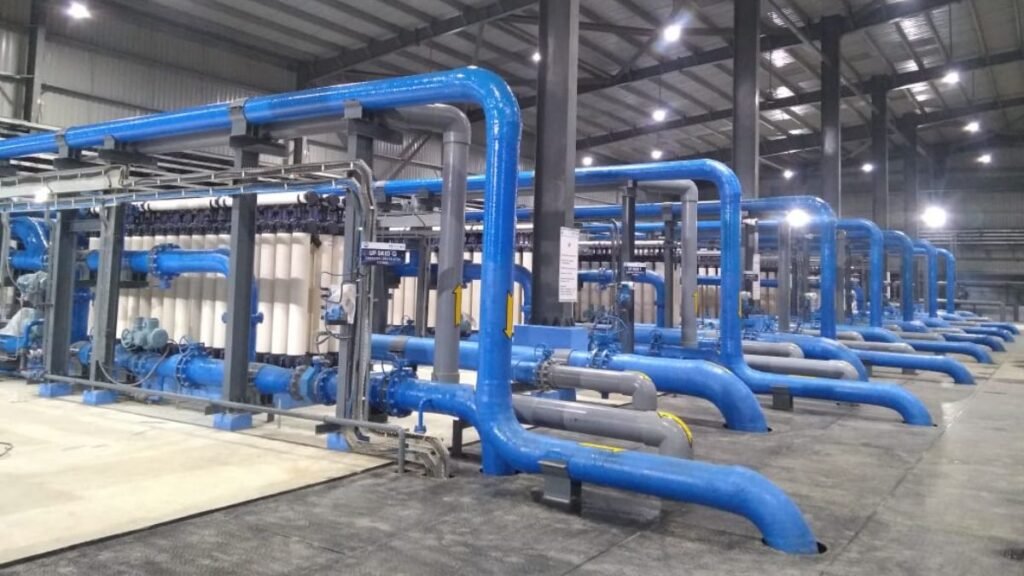
These projects share an underlying philosophy that represents a genuine advance in policy thinking. Treating and reusing water already present in the urban system is more efficient than extracting, treating, and distributing additional freshwater. It reduces pressure on limited surface and groundwater resources, creates a circular water economy, and critically meets industrial demand through a source that is independent of both monsoon variability and inter-state river negotiations. The sewerage investments concurrently underway in Madhavaram, Neelankarai, Palavakkam, and Thoraipakkam are not a separate programme. They are the collection infrastructure that makes this reuse strategy possible at scale. You cannot reclaim water that has not been gathered and treated.
Flood resilience: the basin-level turn
Water security in a coastal city is shaped by two opposite extremes. Drought threatens supply. Extreme rainfall threatens infrastructure, lives, and economic activity. The devastating floods of 2015, which caused losses estimated at over fifty thousand crore rupees, exposed the inadequacy of ward-based drainage as a response to hydrological events that operate at the scale of entire river catchments.
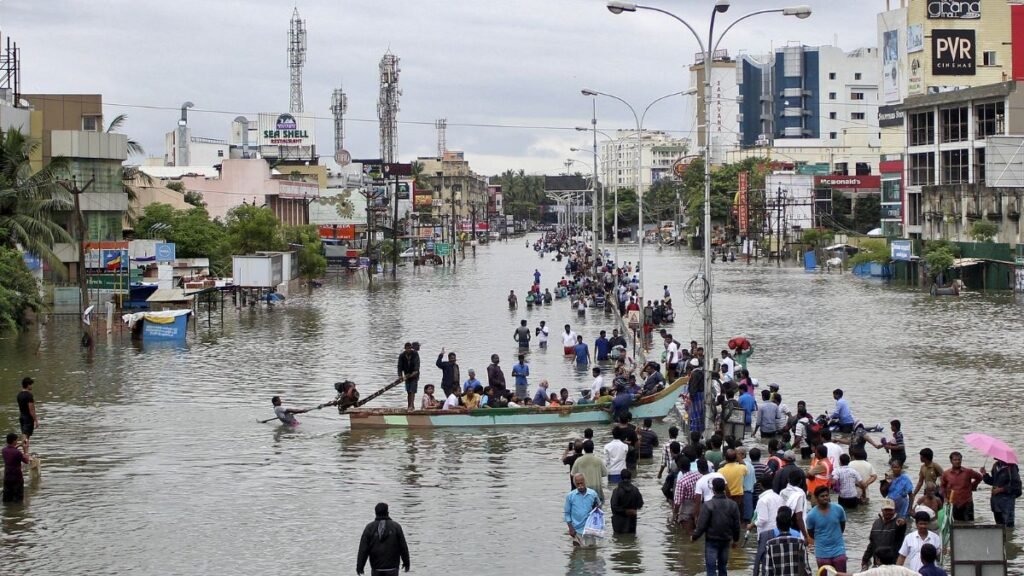
The government’s response was to reorganise stormwater infrastructure around basin-level planning. By aligning investment with the four major river systems – the Kosasthalaiyar, Kovalam, Cooum, and Adyar basins rather than administrative boundaries, the programme moves floodwater management from reactive repair to systemic engineering. This is how cities in the developed world manage urban flooding. That Chennai is beginning to adopt the same approach, at the scale its river systems require, is significant even if full protection demands investment across multiple planning cycles.
Ecosystem restoration: the deeper hydrology
Infrastructure investments in pipes, plants, and drainage systems address the engineered dimensions of water security. But the hydrological base on which all urban water systems ultimately rest – groundwater tables, tank storage, watershed health cannot be sustained by engineering alone.
Tamil Nadu’s parallel programme of irrigation tank rejuvenation and water body restoration addresses this deeper layer. Thousands of minor irrigation tanks, many centuries old, have been desilted, repaired, and structurally improved. These interventions improve groundwater recharge and maintain the hydrological balance of the state in ways that engineered infrastructure cannot replicate. Less visible than desalination plants and ring main pipelines, they are nonetheless essential to the long-term sustainability of the system the visible infrastructure serves.
This is not the concluding section. The section continues in the next part of this series. Part 3 will be published on April 14, 9:00 am.
Jeyannathann Karunanithi is a Chemical Engineer based in Chennai, with a background in Industrial Biotechnology and Environmental Engineering. He works for a global membership association for water professionals, and his interests lie in the urban water sector, approached through the lens of emerging economies where the constraints, the stakes, and the opportunities are distinctly their own.