

Jeyannathann Karunanithi, Chemical Engineer
This is Part 3 of a three-part series examining Tamil Nadu’s long-term water security strategy and infrastructure evolution. This section continues from the previous part and should be read in sequence for full context.
Water as Foundation: The DMK’s Long Game on Water Security in Tamil Nadu | Part 1
Water as Foundation: The DMK’s Long Game on Water Security in Tamil Nadu | Part 2
V. Governing Complexity in Urban Water Systems
Viewed individually, each of these investments might appear as a discrete response to a specific problem: desalination for drought, drainage for flooding, sewerage for sanitation, reuse for industrial demand. Viewed collectively, they reveal a layered strategy in which each component addresses a different dimension of a complex, interconnected challenge.
Urban water systems are not single-issue problems amenable to single-point solutions. They are complex socio-technical systems shaped by hydrology, infrastructure networks, institutions, urban growth patterns, industrial demand, and climate variability. No intervention resolves the challenge in isolation. Resilience requires a portfolio of measures operating at different scales and timescales simultaneously.
It is worth acknowledging honestly that this kind of systemic transition looks messy from the outside, and sometimes from the inside. A growing city must upgrade its infrastructure while continuing to function. Projects overlap, progress is uneven, and multiple instruments operate simultaneously across different institutional layers. District Metered Areas sit alongside new desalination plants. Tank rejuvenation programmes proceed alongside AMRUT (Atal Mission for Rejuvenation and Urban Transformation) funded sewerage works. Basin-level drainage investment continues while industrial reuse pilots are tested in specific corridors.
This is not a policy disorder. It is how large infrastructure transitions actually occur. The practical reality of governing fast-growing, climatically stressed, industrialising cities does not permit the sequential, orderly execution that policy documents imply. What matters is whether the individual components, despite their apparent complexity, are oriented toward a coherent strategic direction. In Tamil Nadu’s case, the evidence suggests they are.
One challenge that deserves clear acknowledgement is the significant level of non-revenue water in the distribution system. In several parts of Chennai’s network, water losses have historically approached forty percent and beyond, reflecting decades of incremental expansion, ageing pipelines, and limited system-wide monitoring. In a system investing heavily in new supply sources, improving distribution efficiency is not a secondary concern and it is of equivalent strategic importance. Every litre lost before reaching a user is a litre that expensive treatment infrastructure produced in vain. The reforms underway in terms of district metered areas, bulk metering, hydraulic modelling, performance-based distribution management are technically appropriate responses. Their full deployment and sustained monitoring will be as consequential to water security outcomes as any new source addition.
VI. From Infrastructure Programme to Long-Term Water Security
If the DMK’s 2021 manifesto represented a policy signal, recognising that water security had become foundational to Tamil Nadu’s development and the 2021-26 infrastructure programme led by M.K. Stalin led Tamil Nadu Government, represented the operationalisation of that signal, then the 2026 DMK manifesto represents something different and in some ways more significant, which is an effort to institutionalise a long-term framework.
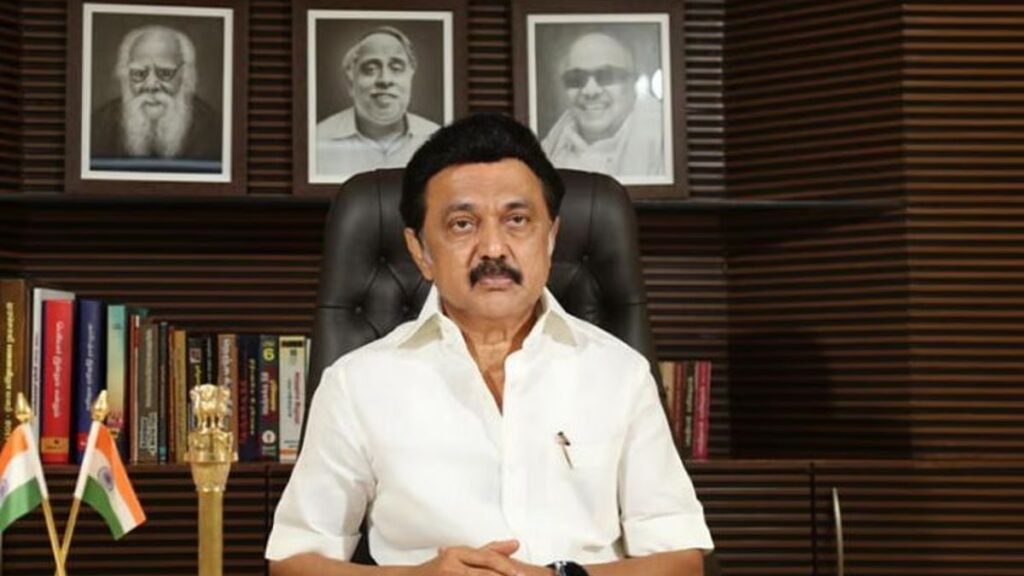
The most consequential commitment is the Tamil Nadu Water Security Plan 2056, a thirty-year planning framework projecting drinking water, agricultural, and industrial demand while creating the institutional architecture required to meet it. This is the appropriate governance response to the infrastructure investments of the preceding term. Having expanded supply sources, begun integrating them through transmission networks, and initiated large-scale reuse of treated wastewater, the logical next step is precisely what this plan attempts: treating water infrastructure as a cumulative engineering system rather than as a sequence of isolated projects responding to periodic crises. India has very few state-level frameworks that operate on this timescale. Water infrastructure operates on generational timelines. Planning horizons must therefore extend beyond electoral cycles if the system being built is to remain functional under conditions of demographic growth, industrial expansion, and climatic variability.
The commitment to raising wastewater recycling to thirty percent extends and scales the reuse strategy that the preceding term established in practice. The Kodungaiyur, Koyambedu, Hosur, and Coimbatore facilities demonstrated that tertiary treatment and industrial reuse can be implemented in a technically and economically viable manner. The manifesto’s explicit reference to tertiary treatment plants reflects important policy maturation. Tertiary treatment produces water of sufficient quality for industrial and non-potable urban use, allowing wastewater to function as a reliable supplementary resource rather than a sanitation by-product.
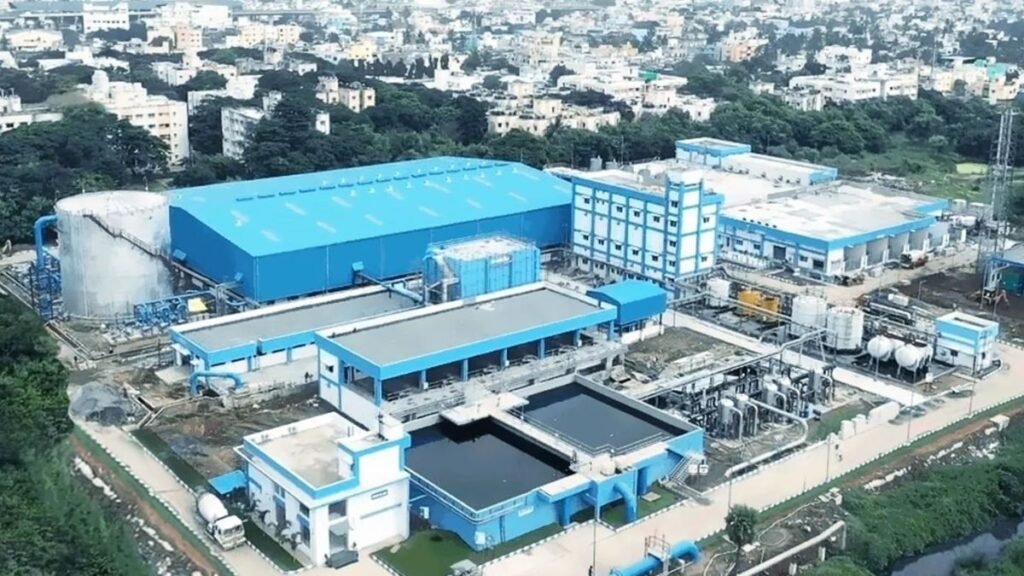
An important principle threading through these investments is that industrial expansion should not occur at the expense of domestic or agricultural water security. Facilities supplying industrial corridors with treated wastewater or desalinated water in Chennai, Thoothukudi, Hosur, and Coimbatore illustrate a deliberate shift in water governance. Rather than drawing on freshwater allocations intended for cities or farms, industrial growth is increasingly supported through dedicated engineered supply. In a water-stressed state, this represents a pragmatic compact between development and sustainability: industrial demand is met through its own supply circuit, reducing competition over limited natural sources.
These investments also serve a broader strategic objective. They reduce dependence on water sources whose availability is shaped by both climatic variability and inter-state river arrangements. Supply diversification, wastewater reuse, and network integration together create a system in which economic expansion can proceed without placing additional stress on already constrained freshwater resources. Seen in this light, the Water Security Plan 2056 is not simply a planning document. It is an attempt to consolidate the lessons of previous decades – institutional, technological, and operational into a framework durable enough to govern Tamil Nadu’s water future across changes in government, climate, and economic structure.
VII. From Scarcity Management to Water Security
What emerges from this trajectory is more than a sequence of infrastructure investments. Over several decades Tamil Nadu has moved gradually from managing episodic water scarcity toward constructing a more durable architecture of water security. The institutions established in the early decades of urban expansion, the technological shifts introduced during periods of acute stress, and the integrated infrastructure strategies now underway together represent stages in that transition.
In the earlier phases of urban growth, water policy was largely concerned with expanding supply through reservoirs, canals, and inter-basin transfers while strengthening the institutions capable of planning and executing large schemes. These interventions were essential in enabling Tamil Nadu’s cities to grow through the latter half of the twentieth century. Yet they remained tied to the same hydrological foundations that had historically defined the region’s water economy. Rainfall variability, limited river flows, and competing demand continued to shape the limits of what these systems could deliver.
The adoption of large-scale desalination marked a significant departure from that pattern. By introducing rainfall-independent supply into the urban water system, it reduced the degree to which metropolitan growth remained hostage to the northeast monsoon and to water sources governed through inter-state negotiation. The facilities at Minjur and Nemmeli did not eliminate scarcity. They altered the strategic calculus of water planning by demonstrating that a portion of the city’s base demand could be secured through engineered sources rather than seasonal hydrology.
The infrastructure programme of recent years extends that logic across multiple dimensions simultaneously. Desalination expands the supply floor. Reclaimed wastewater introduces a circular resource into the urban economy. Ring main transmission improves operational flexibility across the distribution system. Basin-level stormwater planning addresses the opposite hydrological extreme. Tank restoration strengthens groundwater recharge and stabilises local hydrology. Each addresses a different component of the water system. Together they form a layered approach to resilience.
The gradual separation of industrial demand from the freshwater systems that support domestic consumption represents perhaps the most significant governance shift embedded in this strategy. By supplying manufacturing clusters with treated wastewater or desalinated water, Tamil Nadu has begun to establish a practical compact between industrial growth and water sustainability. In a state where urbanisation and manufacturing growth are both accelerating across multiple cities and corridors simultaneously, this separation matters. It means that the next industrial park in Hosur, the next manufacturing cluster in Coimbatore, or the next SIPCOT expansion in Thoothukudi need not come at the cost of the water available to the city’s residents.
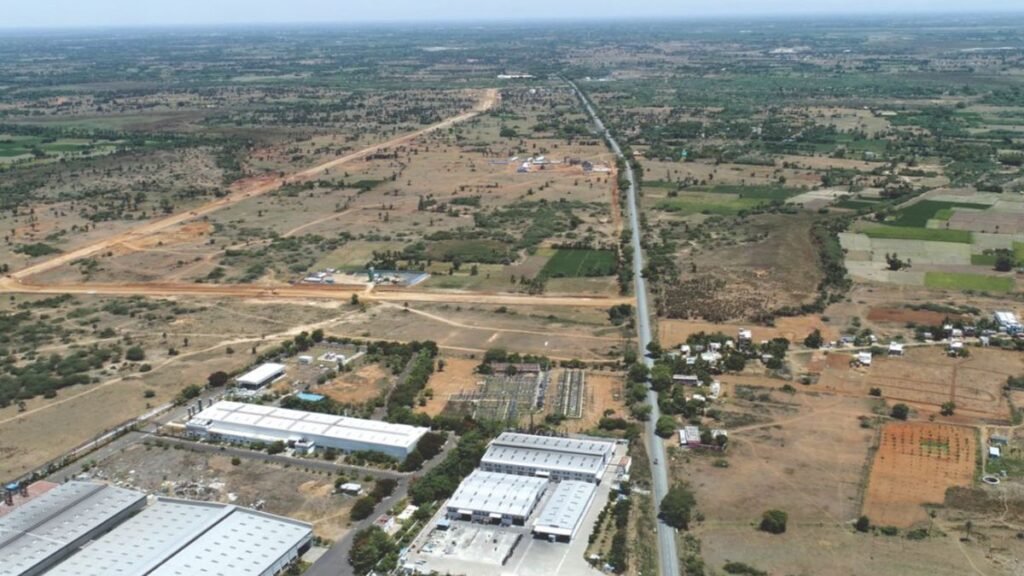
Seen across time, these developments suggest a governing philosophy that has treated water infrastructure as a cumulative system rather than a set of isolated projects. Institutions built in one period have enabled technological choices in another. Infrastructure introduced in response to immediate pressures has later been integrated into broader system design. The result is not a linear policy programme but an evolving architecture in which successive governments have expanded the scope and ambition of the state’s water strategy as new technologies, economic pressures, and climatic realities have emerged.
Conclusion: The Architecture of Development
The events of 2019 made visible what had been quietly accumulating for decades: the fragility of a large metropolitan economy when its water systems approach their limits. What appeared to many residents as a sudden crisis was in fact the culmination of structural pressures – rapid urbanisation, industrial growth, climatic variability that a monsoon-dependent system had no means of absorbing.
The response that has emerged in the years since suggests that the lesson of that moment was understood at its deepest level. Water security is not a welfare programme running parallel to economic development. It is the precondition on which economic development rests. In a semi-arid state where rainfall variability and inter-state river arrangements introduce persistent uncertainty over supply, building water infrastructure that can operate independently of both is not a luxury. It is the foundational act of economic governance.
This logic applies with particular force to Tamil Nadu’s urban geography. Fifteen city corporations, a high degree of urbanisation distributed across multiple industrial nodes, and a manufacturing base that is actively competing for global investment in semiconductors, electric vehicles, and advanced logistics- all of this depends, ultimately, on reliable water. The infrastructure now being built and the model now being replicated from Chennai to Coimbatore to Thoothukudi to Hosur is the answer to a question that Tamil Nadu’s urban economy has been asking for decades.
Cities that function well rarely draw attention to the systems that sustain them. Water moves through pipes beneath the ground, reservoirs stabilise supply quietly, and treatment plants reclaim resources that would otherwise be lost. It is precisely these unseen systems that determine whether urban growth can proceed with confidence.
The architecture of water security now taking shape across Tamil Nadu built step by step, across different phases of the state’s development, in response to both crisis and foresight reflects a governing tradition that has increasingly treated water not merely as a welfare concern but as foundational economic infrastructure. The agricultural water economy of the state, the tank systems and river allocations that sustain farming communities across the delta and beyond, presents a related but distinct set of challenges that this infrastructure alone does not resolve. The urban story told here is one part of a larger reckoning with water that Tamil Nadu must continue to undertake.
But within its scope, the architecture is real, the logic is coherent, and the direction is clear. If sustained and refined in the years ahead, it may prove to be one of the most consequential and least visible foundations of Tamil Nadu’s long-term development.
This concludes the three-part series on Tamil Nadu’s long-term water security strategy and infrastructure evolution.
Jeyannathann Karunanithi is a Chemical Engineer based in Chennai, with a background in Industrial Biotechnology and Environmental Engineering. He works for a global membership association for water professionals, and his interests lie in the urban water sector, approached through the lens of emerging economies where the constraints, the stakes, and the opportunities are distinctly their own.