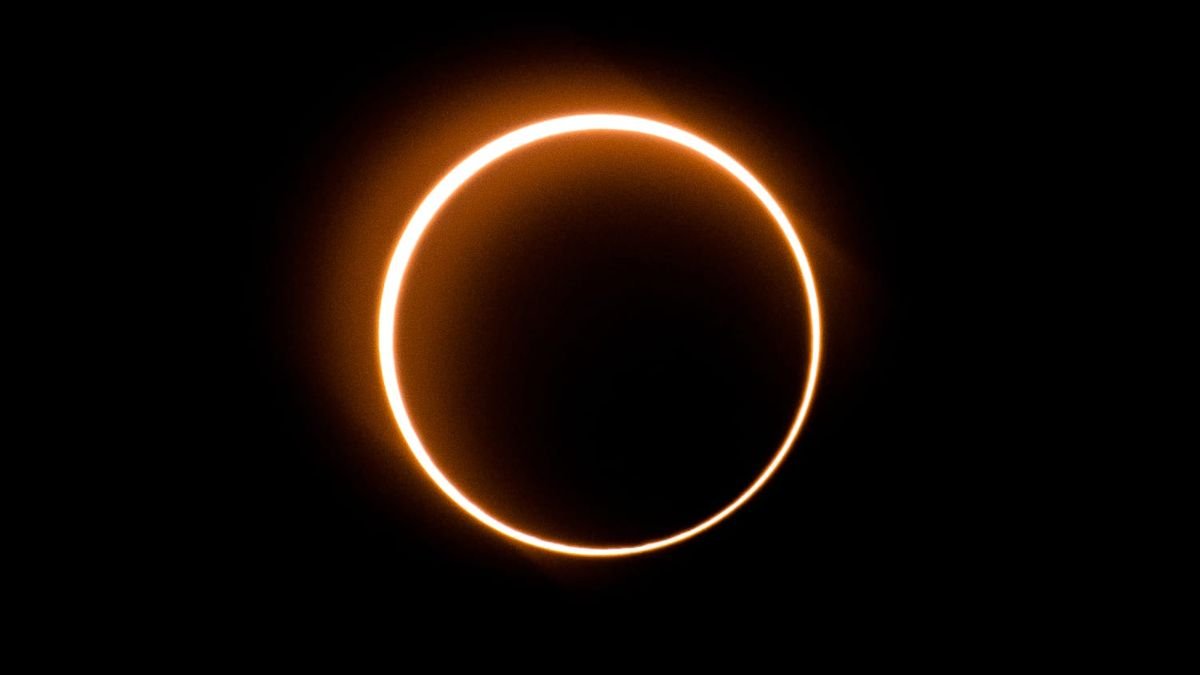
Astronomy enthusiasts worldwide are preparing for a spectacular celestial event as the first solar eclipse of 2026, an annular solar eclipse, is scheduled for Tuesday, February 17, 2026. During this rare phenomenon, the Moon will pass between the Earth and the Sun, but because it is slightly farther from the Earth in its orbit, it will not cover the Sun completely. This creates a striking visual where the Sun appears as a luminous “ring of fire” encircling the dark Moon.
In Indian Standard Time, The solar eclipse on February 17, 2026 will begin with the partial phase at around 3:26 pm. The annular phase, when the spectacular “ring of fire” becomes visible, will start at approximately 5:12 pm, peaking at about 5:42 pm, ending near 6:11 pm. The entire event will conclude with the end of the partial eclipse at roughly 7:57 pm.
Where the Eclipse Will Be Visible
The annular phase of the eclipse, the dramatic ring-like spectacle, will be visible along a narrow, largely uninhabited path across Antarctica and parts of the Southern Ocean. In these remote regions, observers may witness the Moon obscuring up to about 96% of the Sun’s centre at peak alignment, with the luminous solar ring visible for over two minutes at select locations. This will last from about 2 minutes up to roughly 2 minutes 20 seconds at greatest points.
Outside the central path of annularity, a partial eclipse will be observable across southern Africa, the southern tip of South America, and nearby island territories in the Indian Ocean and Atlantic. Cities such as Cape Town (South Africa) and Port Louis (Mauritius) are expected to see a noticeable portion of the Sun’s disk covered by the Moon during the event.
Visibility in India
Despite growing interest among sky watchers in the Indian subcontinent, the eclipse will not be visible from any part of India.
However, astronomy fans in India and around the world can still experience the event virtually via live webcasts and international coverage offered by space agencies and astronomy channels.
Safety Advice for Viewers
Experts stress that never look directly at the Sun without certified solar viewing glasses or proper solar filters, even during an eclipse. Regular sunglasses, cameras, or telescopes without solar filters do not provide adequate protection and can cause serious eye injury.
– Magizh