
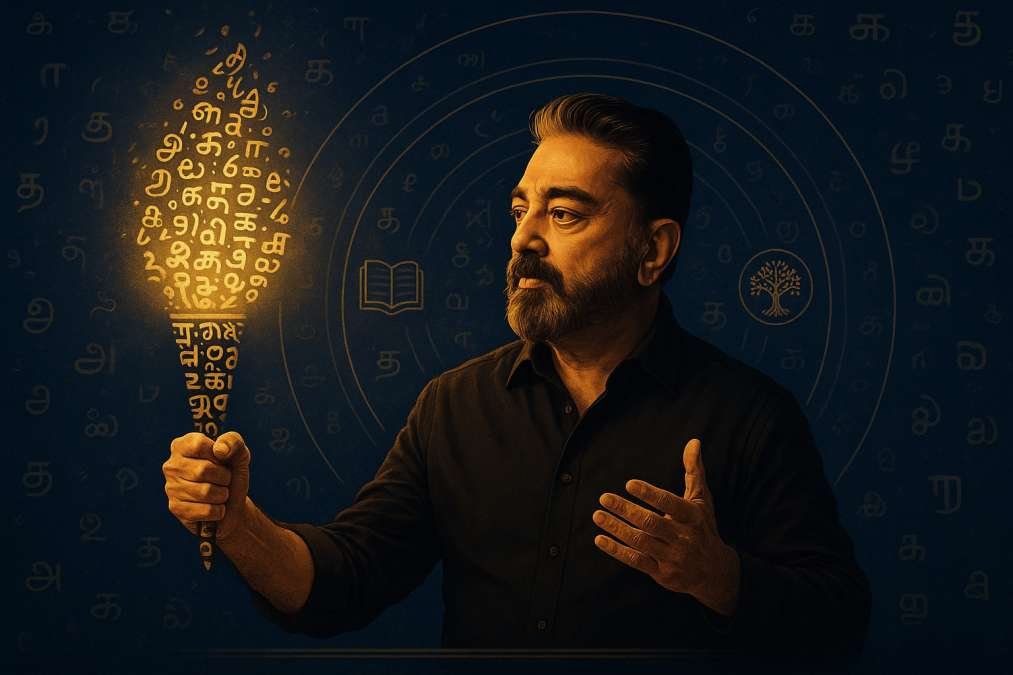
Jalandhar – Actor-politician Kamal Haasan’s recent remark at the audio launch of his upcoming film Thug Life in Chennai — where he stated that “Kannada came from Tamil” — has snowballed into a political flashpoint, particularly in Karnataka. The statement, part of a broader message about Tamil’s literary antiquity and the shared history of Dravidian languages, drew sharp criticism from the Bharatiya Janata Party (BJP) and pro-Kannada groups, who termed it “insulting” and demanded an immediate apology.
But amid the noise, what often gets lost is context.
Kamal Haasan had clarified that his words were not meant to demean Kannada, but to highlight the literary and historical richness of Tamil — an assertion widely made in cultural circles in Tamil Nadu. He referred to the linguistic overlap within the Dravidian language family, stating that Malayalam and Kannada emerged from Tamil, not to establish hierarchy but to illustrate shared roots.
This is not the first time a comment on Tamil’s antiquity has drawn such heat. Nor is it likely to be the last. But what matters is not whether Tamil or Kannada is “older” — a question best left to linguists — but whether such discussions are being weaponised for political mileage at the cost of South India’s shared civilisational heritage.
What Linguistics Tells Us — And What It Doesn’t
Historical and linguistic scholarship offers a clear outline: Tamil, Kannada, Telugu, and Malayalam all belong to the Dravidian language family, believed to have descended from Proto-Dravidian, a now-extinct ancestral language.
Tamil has the oldest surviving literature, with inscriptions dating back to the 2nd century BCE, while Kannada’s earliest inscriptions appear around the 5th century CE. Malayalam branched off from Tamil around the 9th century CE, and Telugu’s literary tradition flourished from the 11th century onward. However, linguists stress that these dates reflect written records, not spoken evolution, and that each language grew independently from the same root over time.
These are facts, well-documented by researchers. What they don’t suggest — and what Kamal Haasan did not claim — is cultural superiority.
Beyond the Binary of Offence and Defence
Karnataka and Tamil Nadu, while shaped by distinct identities, have also shared borders, traditions, and language for centuries. In towns like Hosur, Dharmapuri, Krishnagiri, Mandya, and Chamarajanagar, families routinely speak both Tamil and Kannada. Cultural festivals, religious rituals, and popular cinema are consumed across linguistic lines. The everyday reality of these regions resists the kind of binaries that political outrage seeks to impose.
Yet, in recent years, language has often become an easy trigger. Whether it is Hindi imposition or debates over classical status, linguistic identities are being mobilised — not for cultural preservation, but political gain.
In this case too, it appears that Kamal Haasan’s remarks, far from being a deliberate slight, have been politicised by a party eager to portray itself as the sole custodian of regional pride. That the BJP — a party which has often been accused in the South of ignoring linguistic federalism — is leading this charge, has not gone unnoticed.
Dravidian Unity and the Message Lost in Translation
Kamal Haasan’s statement was rooted in the Dravidian idea — one that emphasises unity through shared ancestry, not division by linguistic timelines. The remark sought to underline the philosophical and cultural continuity of southern India, where languages may have evolved separately but remained tethered to a common civilisational core.
The fact that this idea is now being met with anger rather than reflection points to a worrying trend: the deliberate erosion of South India’s cohesive cultural fabric by injecting political animosity into its deepest connections.
What should be celebrated — the shared Dravidian legacy — is instead being turned into a question of linguistic one-upmanship. And that, more than any remark made at a film launch, should worry those who value the South’s cultural resilience.
The Real Question: Who Benefits From the Divide?
In the end, the question is not about who came first — Tamil, Kannada, or any other language. The real question is: who benefits when these discussions are turned into battlegrounds?
Across Karnataka and Tamil Nadu, ordinary people continue to live in linguistic harmony. They study in multilingual classrooms, work across state lines, consume each other’s cinema, literature, and music. The outrage, many believe, is manufactured — created in digital echo chambers and amplified by political operatives — while everyday life continues to reflect unity far more than discord.
Kamal Haasan’s statement, while controversial to some, serves as a reminder of this unity. It reaffirms that language is not about hierarchy — it is about heritage. And in the South, that heritage is shared.