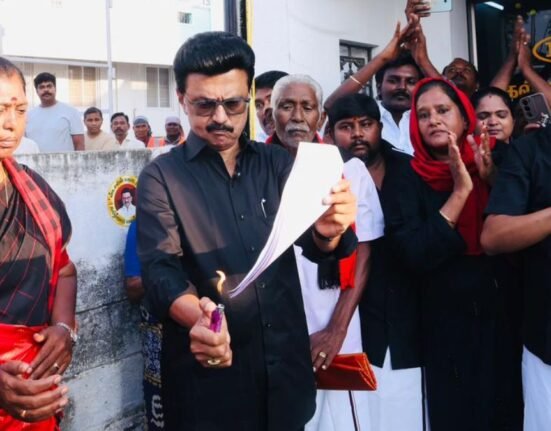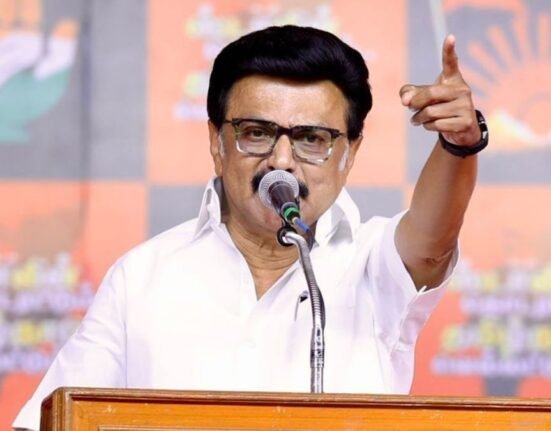


With Tamil Nadu’s polling date now just ten days away, Chief Minister and DMK president MK Stalin is sharpening his campaign rhetoric into a sustained, multi-front assault on AIADMK general secretary Edappadi K. Palaniswami targeting not just the opposition’s governance record but, more pointedly, what he calls the opposition leader’s studied silence on the BJP’s actions in Tamil Nadu and at the Centre.
Speaking at a public campaign rally in Paramakudi in the Ramanathapuram district on Sunday, April 12 a meeting held to garner votes for the Secular Progressive Alliance candidates in Mudukulathur, Ramanathapuram, Paramakudi, and Tiruvadanai constituencies Stalin deployed one of his sharpest rhetorical devices yet, asking the crowd a single, loaded question: “When has Palaniswami ever spoken like this?”
He contrasted the DMK’s track record of governance with what he characterised as Palaniswami’s single-minded focus on personal attacks on denigrating deceased leaders, commenting on others’ deaths, and making undignified remarks about women while going silent on every substantive grievance that Tamil Nadu holds against the Centre.
Stalin listed the failures of the Palaniswami government in stark terms, attaching a city or district to each charge as a rhetorical device: “Pollachi is witness to the corruption; Thoothukudi is witness to the lawlessness; Kodanad is witness to the cruelty; and Sathankulam is witness to the depravity of that government” referencing the Pollachi sexual exploitation scandal, the 2018 Sterlite firing in Thoothukudi in which 13 protesters were killed, the Kodanad estate murder case, and the Sathankulam custodial deaths case in which a father and son died in police custody.
The Chief Minister then posed a series of pointed questions directly at Palaniswami: Does he have a position on the Uniform Civil Code? Has he ever spoken out against the BJP’s three-language policy being promoted for Tamil Nadu? Has he raised his voice against delimitation plans that could reduce Tamil Nadu’s Parliamentary representation plans that, Stalin argued, punish states that controlled population growth? Has he spoken for fishermen who continue to be arrested by the Sri Lankan Navy, while the Centre remains silent? On every one of these, Stalin’s answer was the same: Palaniswami switches to “silent mode” whenever confronted with questions about his political patron’s actions.
He introduced a striking new rhetorical formulation to describe what he sees as the AIADMK’s fundamental compromise: “The AIADMK that once went to the BJP’s washing machine to cleanse Palaniswami’s past now carries its palanquin. Every vote for AIADMK is a vote for the BJP.”
In a notable aside, Stalin quoted Parakala Prabhakar the economist husband of Union Finance Minister Nirmala Sitharaman who had apparently launched a “Zero BJP” movement in Chennai and warned that the Tamil Nadu election is “nationally significant,” and that every vote for the BJP represents a blow to India’s constitutional values of equality, fraternity, social justice, and diversity.
Stalin also made a pointed reference to the Uniform Civil Code noting that while the BJP had included it in their West Bengal election manifesto, they had not dared to make the same promise in Tamil Nadu, because “what protects Tamil Nadu is the Dravidian wall” the legacy of Periyar, Arignar Anna, and Kalaignar Karunanidhi.
The chief minister ended with a sharp, unambiguous declaration to the electorate of Ramanathapuram: “April 23 is the day we will teach a lesson to those whose words fall into the gutter without dignity. The people will drive out the treacherous alliance that has mortgaged Tamil Nadu to selfishness.”
–Samuthiran