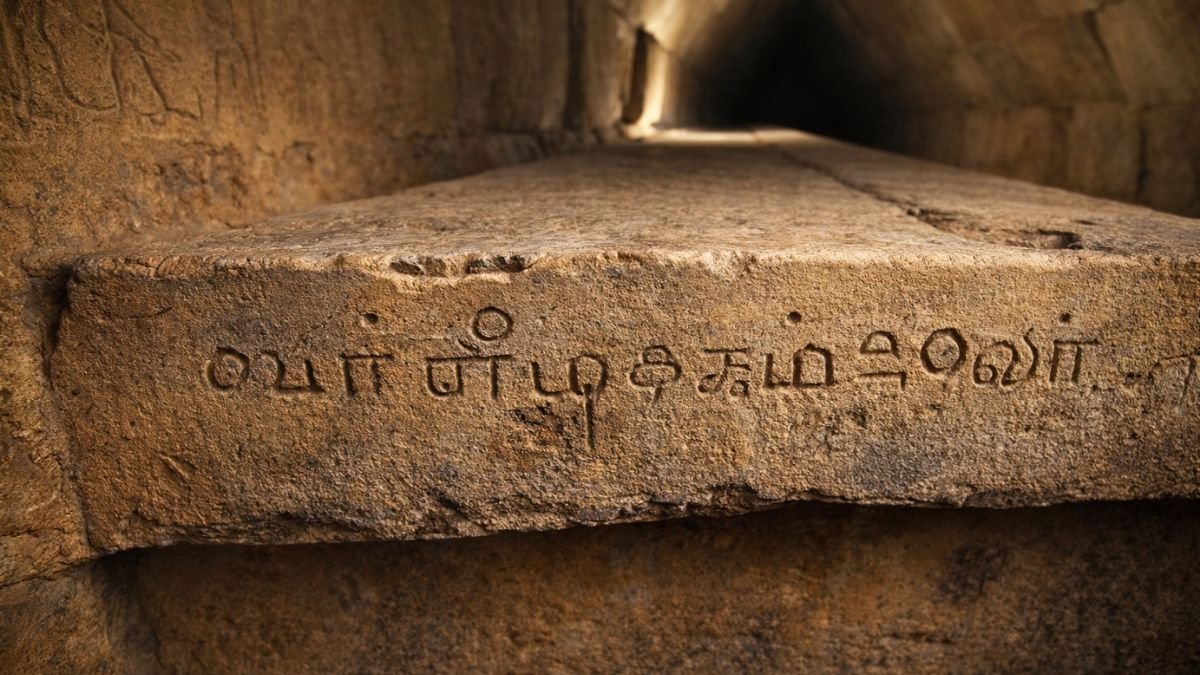
Egypt — In a discovery that promises to deepen our understanding of ancient India–Africa ties, archeologists have identified Tamil Brahmi inscriptions in several tombs near Egypt’s famed Valley of the Kings, suggesting far-reaching maritime connections between South India and the Nile Valley more than two millennia ago.
The inscriptions — found on pottery fragments and stone slabs within the sprawling necropolis — are believed to date back 2,000 years, during the early centuries of the Common Era. Written in Tamil Brahmi, the earliest script form used in the Tamil region, the markings include personal names and merchant identifiers that align with trade practices of the time.
Researchers and historians say the find is nothing short of groundbreaking. It provides tangible evidence that Tamil seafarers were not merely regional voyagers but active participants in long-distance maritime commerce, linking the Indian subcontinent to the Eastern Mediterranean well before the Common Era. The inscriptions were discovered amid a broader excavation project that has already yielded evidence of Sanskrit inscriptions and South Asian imports in other Egyptian tombs, underscoring a cosmopolitan trade environment in antiquity.
Dr. Mahmoud Youssef, an Egyptologist involved in the project, noted that the inscriptions likely belonged to Tamil merchants or sailors who may have visited or resided temporarily at Egyptian ports en route to Mediterranean markets. “This isn’t an isolated script fragment,” Dr. Youssef said. “It’s a chapter opening in the story of how early maritime trade connected distant civilisations in ways we are only now beginning to map.”
Historians point out that evidence of Indian ocean trade — such as Roman coins in Tamil Nadu and beads of South Indian origin in East Africa — has long hinted at ancient networks. But the identification of Tamil Brahmi at the Valley of the Kings provides rare written proof of the Indian presence in Egypt during antiquity rather than mere artefacts of ambiguous origin.
The Tamil Brahmi script, which evolved from the Brahmi family used across the Indian subcontinent, flourished between the 3rd century BCE and the 6th century CE. Its appearance in Egypt aligns with a period when South Indian polities, including early Chera and Pandya chiefdoms, are known to have engaged in maritime trade via the Indian Ocean–Red Sea network, venturing into Arabian and African markets.
Epigraphists studying the inscriptions have identified what appear to be names of Tamil lineage, including some that bear close resemblance to traders mentioned in South Indian inscriptions from the same period. These parallels suggest that Tamil mercantile communities may have been mobile across the Indian Ocean rim, acting as conduits of goods, ideas and cultural links between distant shores.
While further analysis is underway to precisely date and contextualise the inscriptions, the find has kindled excitement among scholars of ancient history and maritime archaeology. It not only enriches the narrative of India’s early global connections but highlights the sophisticated seafaring and commercial capabilities of Tamil society centuries before modern globalization.
As excavations continue, the interdisciplinary team hopes more inscriptions and artefacts will emerge, potentially illuminating previously obscured corridors of human exchange that linked South Asia with Africa and the Mediterranean world in the distant past.