

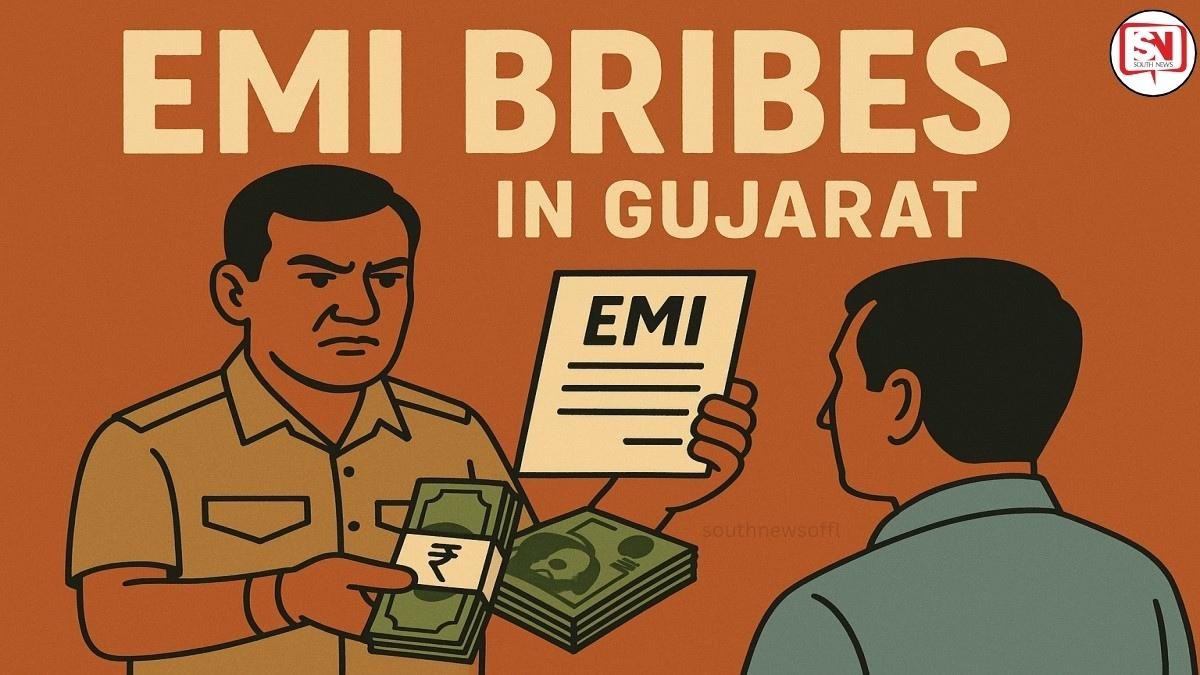
In the vast manual of Indian corruption, where graft is institutionalised and impunity is routine, Gujarat’s bureaucratic ingenuity has introduced a new chapter—bribes in EMIs. No longer content with the traditional envelope under the table, officials are now offering victims the convenience of staggered payments, as if illegality were a service industry equipped with monthly billing plans.
This practice, reported in multiple instances across Gujarat and confirmed by the state’s own Anti-Corruption Bureau (ACB), represents not just a novel form of extortion, but a frightening normalisation of it. That officials could demand bribes and simultaneously offer payment flexibility is symptomatic of a deeper malaise—where power is wielded without fear of consequence, and corruption is rationalised through the language of consumer convenience.
A “Considerate” Corruption
As per reports documented by the ACB, at least ten such cases have emerged in 2024 alone. In one of them, officials demanded ₹10 lakh from a Sabarkantha resident and accepted ₹4 lakh as the first installment. Another case involved a cybercrime officer who allegedly negotiated a similar “installment plan.” These aren’t isolated incidents; they’re symptomatic of a pattern where systemic rot has become self-aware enough to rebrand itself as benign.
The logic—if one can call it that—is twisted: reduce the immediate financial pain of bribery so that citizens can comply without protest. It’s corruption with customer service, abuse of power masquerading as fiscal empathy.
But make no mistake: this is not soft corruption—it is hardened, embedded, and audacious. It reflects not merely the greed of individual officials but the confidence that the system will not punish them, that institutions intended to uphold justice are too weak, too co-opted, or too indifferent to intervene meaningfully.
Gujarat and the Political Context
That this is happening in Gujarat—the state that has long positioned itself as a model of development and governance—is not incidental. The state’s bureaucratic culture is deeply interwoven with a political establishment that has systematically dismantled accountability mechanisms. From underfunded anti-corruption units to a judiciary that too often acts as an extension of executive will, the architecture of impunity is solid.
This culture of corruption is further enabled by the ideological project that governs Gujarat. The state is not merely ruled by the BJP—it is the laboratory of its most aggressive experiments, economic and political. In such a context, the blurring of lines between governance, business interests, and institutional autonomy becomes inevitable. When political loyalty trumps legality, it’s only logical that government offices become negotiation rooms for transactional illegality.
And the silence from the political class is deafening. No minister has condemned these incidents. No ruling party spokesperson has promised reform. It’s not just apathy—it’s tacit sanction.
EMI Bribes: A Structural Failure
This transformation of corruption into a calibrated, almost contract-based activity tells us something chilling. Officials do not fear being caught; they fear non-cooperation from the citizen. Hence, “flexible terms.” And this also speaks to how powerless the average citizen feels—so powerless that even paying a bribe must now be budgeted.
It raises urgent questions: What happens to the complaints lodged with the ACB? What are the conviction rates? Why is it that repeated exposure of such practices has not translated into institutional overhaul? Why is the Chief Minister of Gujarat silent on an issue that strikes at the heart of the rule of law?
Beyond Gujarat: A National Problem
Though this particular pattern is being reported from Gujarat, it would be naive to treat it as an aberration. Across India, corruption adapts to local contexts and economic pressures. But Gujarat’s case is different because it is not just corruption—it is innovation in corruption. And such innovation, left unchecked, will metastasise.
As the central government amplifies slogans about “Digital India” and “Ease of Doing Business,” it would do well to first examine the ease with which its own officials are monetising power in the most cynical ways.
The ACB and the Burden of Proof
The Gujarat ACB has made these disclosures public. That, at least, deserves acknowledgement. But it also puts the burden back on the state. If ten cases were found, how many remain undetected? How many were covered up? And how many victims paid in silence, unable to afford justice even in installments?
A transparent, independently monitored audit of bribery cases—especially those involving law enforcement and revenue departments—is overdue. Whistleblower protections need reinforcement. And above all, the citizens who refuse to pay bribes must be protected, not punished.
Satire as Reality
What should read like a piece of satire—a state offering “bribe EMIs” to ease citizen burden—is in fact a commentary on where we are as a republic. The grotesque is now procedural. That this hasn’t triggered a political storm only reaffirms the depth of our institutional desensitisation.
This is not merely a story about corruption. It is about the cynical rearrangement of power and fear—where justice is too expensive, and crime comes with monthly billing.
And until that changes, no slogan—Gujarat Model or otherwise—will shield this rot from scrutiny.