
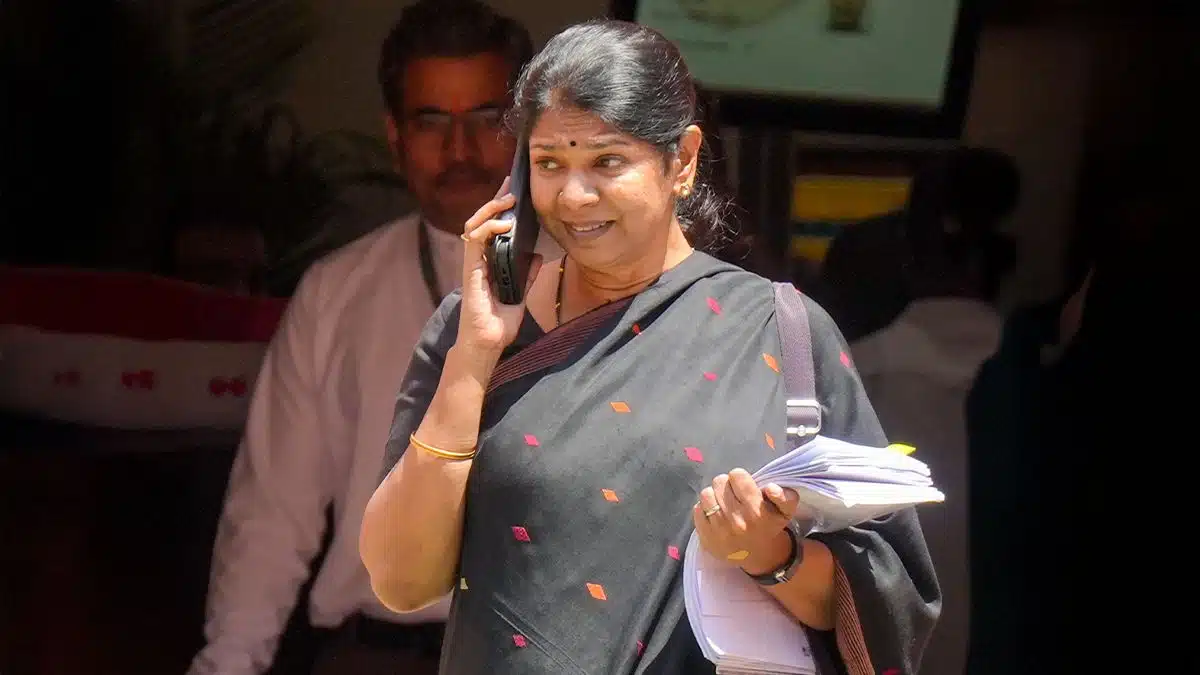
In one of the most sharply argued parliamentary speeches of the special session, DMK Parliamentary Party leader Kanimozhi Karunanidhi stood in the Lok Sabha on Friday, April 17, clad in a black saree a deliberate marker of protest and delivered a forensic, culturally rooted, and politically charged assault on the Constitution (131st Amendment) Bill, 2026, the Delimitation Bill, and what she called the BJP’s fundamental dishonesty in linking delimitation to women’s reservation.
Her speech came a day after Prime Minister Narendra Modi had turned the DMK’s black attire protest into a witticism, thanking opposition members in his Thursday address by saying that just as a kaala teeka (black mark) is applied to protect an auspicious occasion from the evil eye, the black-clad opposition had inadvertently provided divine protection for the legislation. It was vintage Modi deflecting substantive criticism with cultural humour that travels instantly on social media. Kanimozhi came prepared with a counter. Black, she said, is the colour of Goddess Kali, the mother goddess of power, justice, and resistance in Tamil and wider Hindu tradition. There was nothing negative about the colour they wore; it was the colour of their defiance and their conviction.
Having dispatched that, she moved to substance.
“Eight crore people have been told their votes will count for less”
Addressing the House, Kanimozhi made her framing explicit from the outset: “I not only stand as a representative of the DMK but also of eight crore people who have been told, amidst their own elections, that their votes will count less and their voice in this Parliament will be diminished. These three bills, disguised as support for women’s reservation, constitute the single greatest assault on the federal structure of this country.”
She challenged the timing of the Nari Shakti Vandan Adhiniyam’s gazette notification published the previous night, while Parliament was simultaneously debating the very Bill tied to it. “We are discussing the Bill here, so what was the need to notify it yesterday? What is the respect you have for this House?” she demanded.
Her core argument was a precise demolition of the government’s central claim. The BJP, she said, was using women as a human shield hiding the poison of delimitation behind the shield of women’s reservation. The two issues are constitutionally distinct, she argued; delimitation has been carried out in India’s past without changing the total number of Lok Sabha seats, merely redrawing boundaries within states. The demand to expand the House to 850 seats is an entirely separate question and the one southern states are at war with.
The fertility rate argument
Kanimozhi’s most powerful statistical salvo was demographic. Tamil Nadu’s current fertility rate is 1.6 lower than France, lower than Australia, lower than the United States. Since 1971, Tamil Nadu’s population has grown by 15 per cent. Uttar Pradesh’s has grown by 120 per cent. Southern states listened when successive governments urged population control. They complied. Their fertility rates fell. And now, she said, they were being punished for their compliance.
“We listened to the government’s call to control the population. We complied. In 2001, there was a government which understood this injustice and gave us 24 more years. Why do we have to increase seats to 850 now? The statement of objectives states that demographics have changed yet you are using 15-year-old 2011 census data to conduct delimitation. You are contradicting yourself.”
She invoked Periyar: “Our ideological leader taught us that justice is not giving everyone the same thing. Justice is giving every person what they need and deserve.” Under the 2011 census, she pointed out, UP gains 13 seats and Tamil Nadu loses 11, a fact she argued was directly contrary to Home Minister Amit Shah’s assurances the previous day that southern representation as a percentage would hold steady.
Against the Delimitation Commission’s structure
Kanimozhi also attacked the institutional design of the proposed Delimitation Commission. The Bill, she noted, vests authority in a commission chaired by a retired Supreme Court judge appointed by the Union government with no consultation with the Chief Justice of India and no role for state governments. The census to be used is left deliberately unspecified, allowing whichever party holds power at the Centre to choose which data serves its purposes. “The Bill is vague and leaves everything open. This shows either a non-application of mind or a mind determined to push its own agenda on this country.”
She also condemned the choice to convene this special Parliament session in the middle of Tamil Nadu and West Bengal’s election periods, calling it a deliberate provocation timed to maximise political impact while minimising opposition capacity to organise.
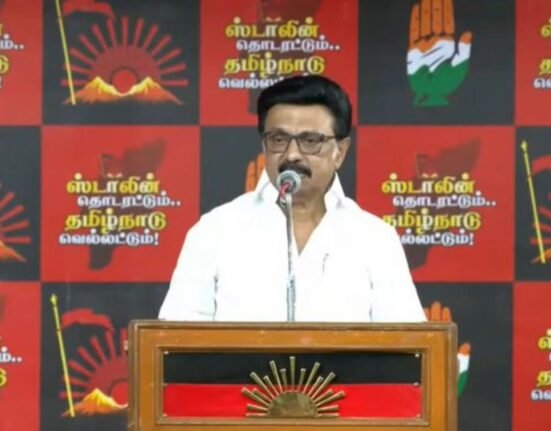
Back in Tamil Nadu, the messaging was even more visceral. Chief Minister M.K. Stalin burned a physical copy of the Delimitation Bill on April 16, calling it a “black law” that would turn Tamils into refugees in their own land, and kicked off statewide protests across the state.
–Samuthiran