
It is often said that the strength of a democracy is reflected in the independence and integrity of its judiciary. But when a judge becomes the subject of sustained criticism for perceived partisanship, controversial courtroom conduct, and questionable affiliations, it is not merely the individual who is under scrutiny — it is the system that allowed her to rise.
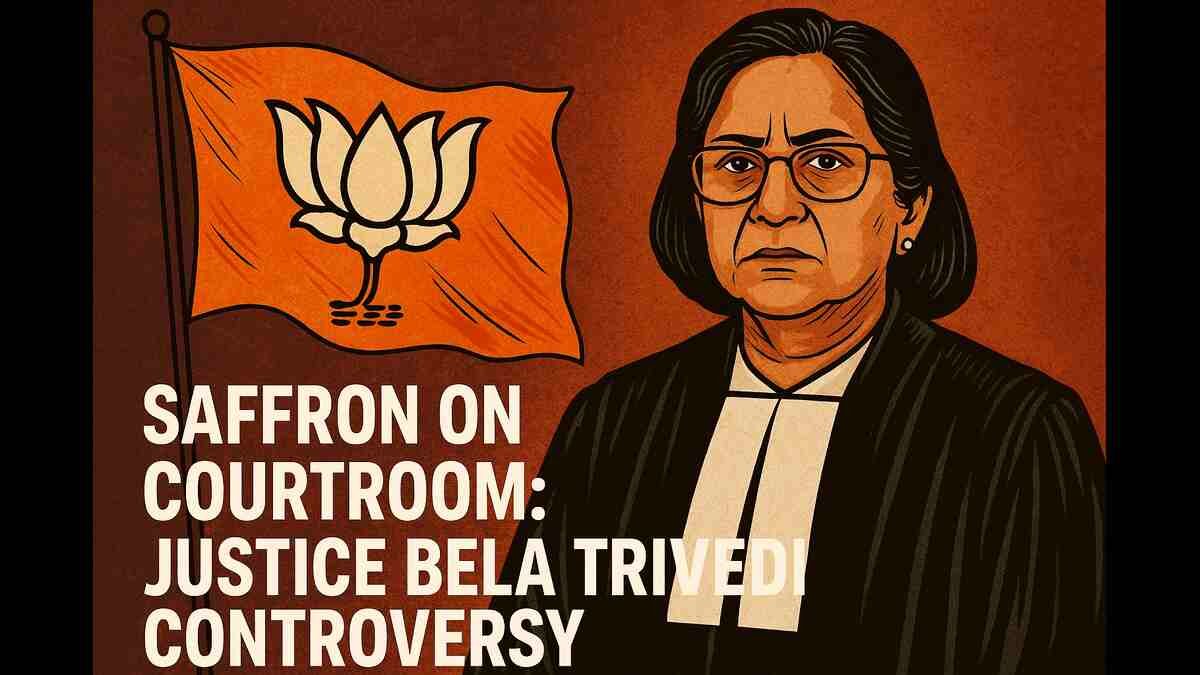
Justice Bela M. Trivedi of the Supreme Court of India is increasingly seen as a disquieting presence on the bench. Her judgments, her tone in court, and her background have generated concern among lawyers, rights defenders, and a growing section of the public. Many now believe that her elevation, and the power she wields from the apex bench, signal a dangerous shift in the judicial temperament of the court — from independence to ideological compliance.
A particular flashpoint in recent memory came when senior advocate Indira Jaising appeared before the bench in a case pertaining to hate speech and communal incitement. Instead of being met with the respect due to a veteran lawyer known for her human rights work and previous service as Additional Solicitor General, Jaising was interrupted brusquely. Justice Trivedi snapped that lawyers should “stop talking like politicians” and appeared visibly impatient with arguments that challenged state impunity. The hostility was not just disproportionate, it was telling — and not an isolated incident. It followed a pattern seen before in her courtroom: of intolerance toward dissenting lawyers and excessive deference to the state’s position.
The real concerns about Justice Trivedi, however, lie not merely in her courtroom behaviour but in her background and affiliations. Before her elevation to the apex court, Trivedi served as a judge in Gujarat — a state where the line between judiciary and ruling party interests has often been disturbingly thin. Several reports and legal insiders have spoken, albeit off the record, about her proximity to BJP leaders in the state, including individuals with deep roots in the Rashtriya Swayamsevak Sangh (RSS). In fact, multiple legal observers believe her rise within the judiciary was fast-tracked through these connections — a claim that gains credence when one considers her decisions and silence in cases with serious implications for accountability and civil liberties.
Her involvement in sensitive cases concerning communal violence, including some dating back to the Gujarat 2002 riots, has also raised eyebrows. There are allegations that she chose to recuse herself — not because of any conflict of interest, but because her presence on the bench would have made a fair hearing untenable in the eyes of the victims. Yet, she made no disclosure or explanation in the public domain, reinforcing suspicions of bias. This silence, in matters where transparency was morally — if not legally — mandated, has damaged the judiciary’s credibility further.
One controversy that has refused to die down is her alleged proximity to Chandra Sutt, a little-known but politically influential businessman in Gujarat with strong links to the Sangh Parivar ecosystem. It is believed that Sutt has acted as a bridge between the judicial establishment and BJP functionaries in the state. While concrete proof of this relationship remains elusive, the fact that such allegations are being widely whispered about in legal circles — and not credibly challenged or disproved — points to a trust deficit that the judiciary can ill afford.
Then there are her judgments. Justice Trivedi has consistently sided with state authority in cases involving sedition, bail, and preventive detention — areas where a cautious, rights-respecting approach is essential. Her reasoning often borrows liberally from executive arguments while downplaying constitutional protections. In cases involving the Unlawful Activities (Prevention) Act (UAPA), she has been reluctant to acknowledge the abuse of the law or the procedural violations that have become routine. When the liberty of citizens is weighed against the convenience of the state, she has shown a disturbing tendency to tip the scales in favour of the latter.
It is this combination — of ideological proximity to the ruling party, a hostile attitude to human rights lawyers, and jurisprudence that enables state overreach — that has drawn ire from the legal community. What makes the situation worse is the lack of institutional accountability. The collegium system, opaque as it is, has allowed such appointments to proceed without rigorous scrutiny. And when justices like Trivedi continue to deliver verdicts that align seamlessly with the political imperatives of the BJP, it raises the spectre of a compromised judiciary.
To label Justice Trivedi’s tenure as merely controversial would be to understate the problem. She is emblematic of a broader trend: the quiet and deliberate erosion of judicial independence from within. A judge may not wear her ideology on her sleeve, but when her conduct, affiliations, and rulings all appear to lean one way — when justice is not just done but visibly skewed — then the damage to public faith is profound and lasting.
Judges are not above criticism. And when their actions suggest that they see themselves not as arbiters of justice but as extensions of executive will, that criticism must be sharp, unsparing, and public. Justice Trivedi may continue to sit on the bench, but her growing unpopularity among constitutional scholars, civil rights advocates, and conscientious lawyers is a sign of the times. She is not just a discouragement to the judiciary — she is its mirror. And what we see reflected there should worry anyone who cares about democracy.