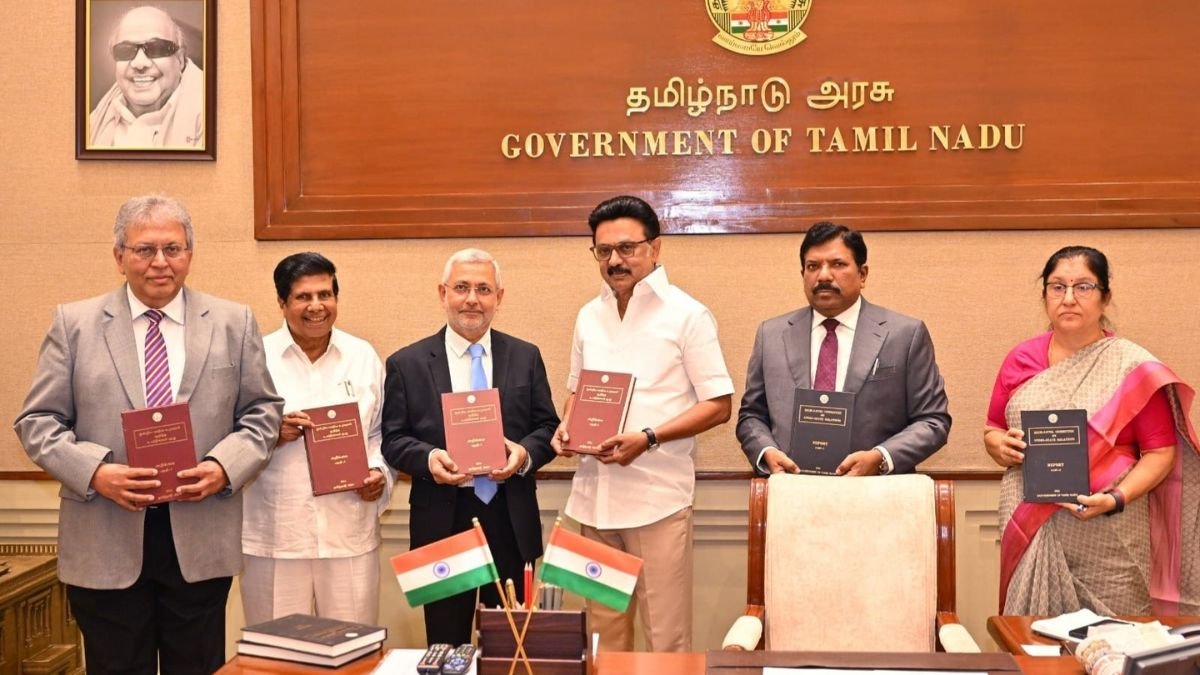
Chennai — In a significant intervention in India’s federal discourse, a high-level committee chaired by former Supreme Court judge Justice Kurian Joseph has submitted its initial report on Centre – State relations to Tamil Nadu Chief Minister M.K. Stalin, proposing sweeping structural reforms including curtailing gubernatorial powers, revisiting language policy and amending constitutional provisions governing federal balance.
The panel, constituted by the Tamil Nadu government to examine evolving tensions between the Union and States, has recommended a recalibration of constitutional mechanisms to strengthen state autonomy. Among its key proposals is the introduction of a fixed tenure for Governors, clearer limits on discretionary powers and a more consultative process in their appointment effectively reducing the scope for political friction between Raj Bhavans and elected State governments.
The report also suggests re-examining the Governor’s role in withholding assent to Bills and in recommending President’s Rule, arguing that constitutional ambiguities have contributed to administrative standoffs in several States.
Chief Minister Stalin, receiving the report in Chennai, described it as a “serious and scholarly effort” aimed at restoring the spirit of cooperative federalism. He reiterated his long-standing position that India’s constitutional architecture must evolve to reflect contemporary realities. “Federalism must not remain a theoretical ideal,” he said, adding that structural clarity is essential for stable governance.
The panel has also addressed language policy, calling for greater sensitivity to India’s linguistic diversity and cautioning against what it described as centralising tendencies in educational frameworks. While not opposing multilingualism per se, the report stresses that States must retain the final say in implementing language education models suited to their sociocultural context.
In addition, the committee has reportedly proposed strengthening the Inter-State Council and institutionalising regular Centre–State consultations on fiscal and administrative matters. It underscores the need to revisit financial devolution mechanisms to ensure predictable and transparent fund flows to States.
The report is expected to be tabled in the Tamil Nadu Assembly, after which the State government may initiate consultations with other States to build consensus around federal reforms. Observers note that the recommendations, though originating in Tamil Nadu, have broader national implications at a time when multiple States have raised concerns about gubernatorial intervention and fiscal centralisation.
If pursued at the national level, the proposals could trigger a wider debate over constitutional amendments a move that would require significant parliamentary backing. For now, the submission of the Justice Kurian Joseph panel’s report marks a bold attempt by Tamil Nadu to reshape the contours of Indian federalism and reassert the autonomy of States within the Union framework.