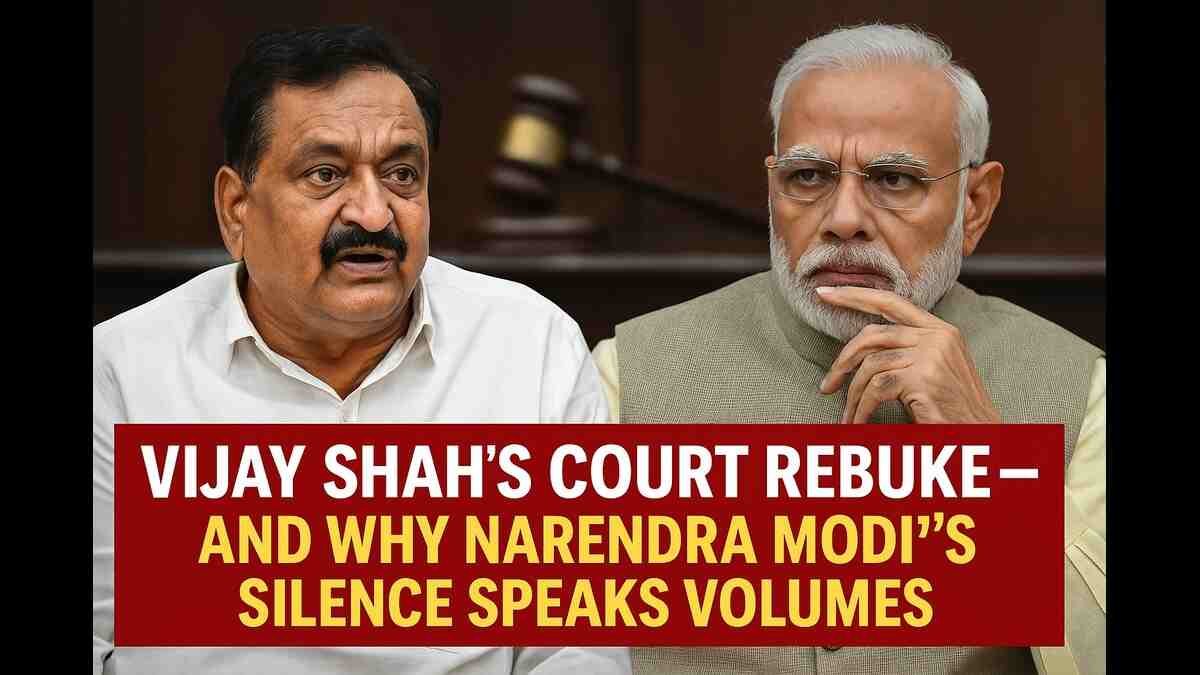
When a sitting minister in Madhya Pradesh uttered a communal and sexist slur against a decorated army officer, what followed was not just public outrage, but a sharp intervention by the Supreme Court. Yet, the Prime Minister—usually quick to claim the moral mantle of ‘Nari Shakti’ and institutional integrity—chose silence.
The incident involving Tribal Affairs Minister Kunwar Vijay Shah took a decisive turn when the Supreme Court described his remarks as “derogatory, sexist and communal.” The bench not only rejected his televised apology as insincere but also ordered a probe by a court-monitored Special Investigation Team composed of officers from outside the state. It made clear that legal impunity would not be tolerated and that the law must take its own course.
This judicial response marked another instance in which the courts have had to compensate for the silence of the political executive. A pattern emerges: a member of the ruling establishment makes a provocative remark; the party either defends, distances or delays its response; and only after the judiciary intervenes does accountability begin to materialise.
What makes Prime Minister Narendra Modi’s silence especially conspicuous is his consistent positioning as a champion of discipline, nationalism, and women’s empowerment. He has often used these themes to project a clean and modern image of his government. But when one of his own party’s ministers makes a comment that disparages not only a woman but also a decorated military officer, the absence of condemnation is glaring.
There are political calculations at play. Vijay Shah holds strategic importance within the BJP’s social coalition in Madhya Pradesh, especially as the state gears up for upcoming elections. Rebuking him publicly could risk upsetting the party’s internal caste and factional arithmetic. Silence, in this calculus, is safer than alienating a segment of the party’s core support base.
Moreover, by allowing the courts to act as the primary site of accountability, the central leadership avoids the appearance of internal dissent or disciplinary action. This tactic of letting the judiciary clean up political messes allows the government to preserve its image without taking direct responsibility. It’s a familiar strategy: deflect until forced to address the issue, and even then, do so minimally.
But there are consequences to this approach. Within the armed forces and among veterans, there is growing unease at the politicisation of uniformed personnel. When a serving officer is attacked not for professional lapses but for her religious identity and gender, and when the Prime Minister remains silent, it sends a troubling message about what kind of discourse is tolerable under the current political regime.
This episode mirrors previous instances where accountability only followed judicial pressure. Whether it’s hate speech, communal violence, or institutional overreach, the Centre’s tendency has been to stay quiet until compelled to act. It reflects a governance model where optics are prioritised over moral clarity, and silence is weaponised to maintain political equilibrium.
In the broader landscape, the Prime Minister’s silence raises fundamental questions. Can a government that projects strength and clarity afford to ignore a minister’s communal and misogynistic attack on a national servicemember? Or does silence imply complicity?
As of now, the courts have taken a firm stance. Whether the Prime Minister will match that resolve with moral leadership remains an open—and increasingly urgent—question.